- Introduction
- James Bradfield (1736-1807)
- Charles Henry Coote (1725-1802), 7th Earl of Mountrath
- Sir Charles Coote (1581–1642)
- Charles Coote, (1610-1661) 1st Earl of Mountrath
- Charles Coote (1655-1709), 3rd Earl of Mountrath
- Algernon Coote, (1689 –1744) 6 Earl of Mountrath
- Charles Coote (c1725–1802), 7th, and final, Earl of Mountrath
- Footnotes
Introduction
Many readers will be aware of the original school in Stoke Ferry, built in 1819. It was named after James Bradfield. He bequeathed it for the education of 25 poor boys and girls from Stoke Ferry and Wretton. Some may also be aware of Bradfield Place in Stoke Ferry. And, through reading Richard Coates’ excellent history of Stoke Ferry; A Farthing for the Ferryman, others may know of the link between James Bradfield and the 7th Earl of Mountrath. But I thought I might take this opportunity to explore the connections and the history of these two men a little further.
James Bradfield (1736-1807)
James was born in Beetley, just north of Dereham. He married Sarah Worns (1738-1793) of Stoke Ferry. They had three children, including Sarah Bradfield. Sarah married Charles Sanders. She had seven children with Charles, including another Sarah. Another Sarah died in Stoke Ferry in 1851. Their impressive family memorial can be visited in the churchyard of the redundant church of All Saints, Stoke Ferry. James must have been a bright and energetic young man. He became the owner of most of the 1,900 acres of land that comprised the parish of Stoke Ferry. It is thought that he and his family lived in the Manor House, Wretton Road. Upon his death he was described as having “a very fine landed estate and considerable fortune”. It was around 1780, aged 46, that he became the land agent for the Irish colonial estates of a number of absentee English landlords1 and especially for the 7th Earl of Mountrath, Charles Henry Coote (1725-1802), who had a country seat at nearby Weeting Hall.
7th Earl of Mountrath, Charles Henry Coote (1725-1802)
As well as his country seat at Weeting Hall (pictured), the Earl had a further 52-acre estate in West Dereham (the mansion of Dereham Abbey), as well as tenant farmers on enclosed lands in West Dereham and Crimplesham.

Weeting Hall
Charles was very involved in local affairs, especially those which met his personal interests. In 1770 the Stoke Ferry Trust was established. It aimed to create toll roads. These roads would connect the landed estates of the 7th Earl of Mountrath (Hockwold/Weeting), Sir Hanson Berney (Barton Bendish), Sir Richard Bedingfeld (Oxborough), and John Dashwood (Cockley Cley). All these roads connected to the commercial centre and inland port of Stoke Ferry. Trustee meetings were held in the Crown Inn, Stoke Ferry. They were held to monitor progress of the necessary Acts of Parliament and operational issues. They also pursued a 1791 extension and widening of the toll roads “from the end of the present turnpike road, near the gate going on to Methwold Warren, to Weeting-hill, near a plantation belonging to the Earl of Mountrath…”. The Trustees’ monopoly of the road transport system was later enhanced by their land clearances and enclosure acts for their Parishes. Naturally, as James Bradfield was also a major landowner in the area, Bradfield’s interests overlapped with those of the Earl.
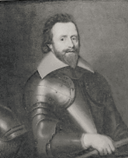
James Bradfield is buried in Ireland. He was the leading land agent for the 7th Earl. I think it is worthwhile to see how the Coote family acquired their Irish estates and great wealth. In the year 1600, Sir Charles Coote (1581–1642) (pictured) was just 19 years old. He led the 100th Foot Regiment of a British army in an invasion of Ireland. He was the commanding officer in various battles. For his service, he was rewarded with Irish estates in Connaught. By the time of his death, these estates provided him with a handsome annual rental income of £4,000. He was a ruthless coloniser. When he launched attacks on County Wicklow many civilians died. He was described as “carrying out inhuman and promiscuous murders of the people of Wicklow”. He had particular success as an unrelenting and violent troop commander in battles around Mountrath. This was in Queen’s County (now re-named County Laois) in central Ireland. On April 2nd, 1621 he was made a baronet of Castle Cuffe, Queen’s County. He had a son, Charles who was to be appointed the 1st Earl of Mountrath.

Sir Charles Coote (1581–1642)
Charles Coote, 1st Earl of Mountrath (1610-1661)
The first Earl implored King Charles I to instigate harsh anti-Catholic measures. These measures included the building of walled cities in every county of Ireland. No Catholics would be allowed to live within those walls. The King rejected his demands. This rejection resulted in Coote joining with Cromwell’s Parliamentarian Army2 and forming and commanding his own military troop of British colonial settlers. Throughout the Cromwellian Irish wars the Earl was ruthless in his endeavours to crush Catholic Irish resistance. Upon defeating the Irish Ulster Army of Bishop Heber McMahon and leaving 2,000 dead, he is reported to have caused the Bishop “to be hanged with all the circumstances of contumely [insulting treatment and language], reproach, and cruelty, which he could devise.” This battle removed the last field army of any strength to oppose Parliamentarians in Ireland. It also secured for them the northern province of Ulster. In June 1651 he effectively led his army on Athlone. This opened up the Province of Connaught, across the Shannon, to the Parliamentarian army. Then, in the winter of 1651-2, Charles successfully besieged the highly fortified port of Galway. After suffering hunger and disease, the town’s population finally surrendered. This success resulted in Charles being appointed President of Connaught. After fighting for the Parliamentary republican cause he then backed the restoration of the monarchy. In December 1659, he took part in a coup against the government, and seized Dublin Castle. He then sent a representative to the exiled Charles II, inviting him to make a military attempt on Ireland. Following the Restoration of the monarchy, he built the family residence of Rush Hall near Mountrath. However, the following year he died of smallpox. He is buried in Christchurch Cathedral, Dublin and his son, Charles Coote, (c. 1630–1672), became the 2nd Earl of Mountrath.
Then, a further Charles; Charles Coote (1655-1709), became the 3rd Earl of Mountrath. He appears to have suffered considerable losses when his estate was forfeited during the Jacobite wars. However, he was a favourite of the court of King William and when the wars ended he was granted estates forfeited from Lord Slane (possibly in County Meath, 1703). The 3rd Earl became a member of several parliamentary committees, notably those proposing anti-Catholic measures. He was one of fourteen peers who voted for a Bill restricting catholic voting rights. He died in 1709 and was buried in England at Wing, Buckinghamshire. He had two sons, Charles (4th Earl) and Henry (5th Earl), who both died young and unmarried.

Dispatching the Superabundant Population, Trinity College Dublin, relates to the cruelties committed by Sir Charles Coote in Mountrath, where he “disposed” of “Popish peasants” by shooting them in the mouth.
Which leads us to Algernon Coote, the 6th Earl of Mountrath (1689 –1744)
He was educated in England at St Paul’s School, London and Trinity College, Cambridge. As his earldom was Irish, he was also able to sit in the British House of Commons as MP for Castle Rising, Norfolk. He also became Governor of Queen’s County, Ireland and a member of Ireland’s Privy Council. Importantly for our story he was very much an absentee landlord.3 The Book of Maps is a 1730 survey of all the lands owned by the 6th Earl. The book is part of the Trinity College Dublin collection. It shows that as well as holding lands in Queen County the Earl also had holdings in County Leitrim, County Offaly, Roscommon, and County Kildare. By 1794 Algernon was residing at Weeting Hall, Norfolk. He also had a bathing seat at Hunstanton in Norfolk, and suburban seats at Turnham Green and Twickenham Park in London. He had a further seat in Devon, and, in order to avoid staying at roadside inns at which he was certain he would catch smallpox, as had happened to the 1st Earl back in 1661, he built five houses between Devon and Norfolk.
The 6th Earl had just one child, Charles; Charles Coote (c1725–1802), the 7th, and final, Earl of Mountrath.
It was he who appointed James Bradfield as his principle Irish Agent to collect rents and deal with the Charles’ colonial financial affairs. James also represented the Earl in various high-level political wheeler-dealings. James Bradfield probably lived in one of the Georgian houses on Coote Terrace, Mountrath, which was then the fashionable living quarters of wealthy Protestants and where several of the Earl’s agents lived.

Coote Terrace today (Google Maps)
In line with common practice of the time, James Bradfield will have taken as his fee 12d (5p) in every pound of rent he received from tenants on his English Lord’s numerous estates. He will have also received fees for arranging leases of land to Catholic tenants (Catholics were not allowed to own land). And it was from such earnings, along with rents from his extensive holdings in Stoke Ferry, that James was able to bequeath money for the village school.
Footnotes
- An absentee landlord is a person who owns and rents out a profit-earning property, but does not live within the property’s local economic region. ↩︎
- The Puritan Revolution (1640-49) ended with the execution of King Charles I. England then became a Republic until a constitutional monarchy ( Charles II) was established in 1660. The Cromwellian Wars in Ireland,1649–1653, led to the English re-conquest of Ireland. ↩︎
- During the 16th and 17th centuries, most of the land in Ireland was confiscated from Irish Catholic landowners and granted to Protestant Scottish and English settlers, nobles and soldiers, some of whom rented it out to the Irish, while they themselves remained in Scotland and England. By 1782 around £800,000 was transferred out of Ireland annually to absentee landlords resulting in the wealth from the land being exported. ↩︎
2 responses to “James Bradfield and the 7th Earl of Mountrath”
-
[…] was made and invested in our Wissey Valley district from the fortunes made by Methwold ’s Earl of Mountrath and Stoke Ferry’s James Bradfield from estates in colonial […]
-
[…] Estates of Sir Berney, Sir Bedingfeld, John Daswood, Earl Mountrath […]
Leave a Reply