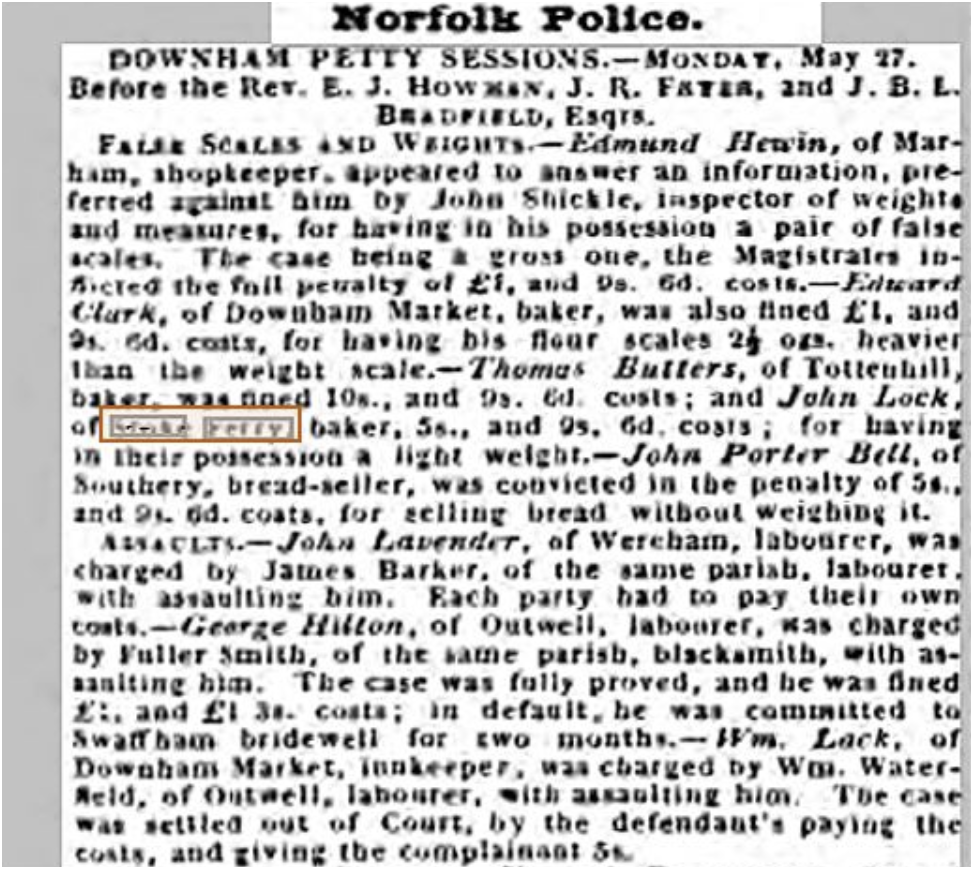
Below are examples of the Victorian English legal system, mainly in its Petty Sessions. We have highlighted newspaper clippings of cases involving residents of Stoke Ferry, but there are also a few other cases listed that are also of interest. Descriptions of four Justices of the Peace who delivered punishments to the population in our district can be found here.
Stoke Ferry can be seen as a microcosm of the system in use across rural England at that time. The criminal cases include: ‘shooting a tame pigeon’ (judgment 11 shillings), ‘stealing turnips’ (15 shillings plus 14 days in prison), ‘concealing the birth of a child’ (one month in prison), ‘forged cheque’ (12 months hard labour ), ‘selling underweight bread (£1.9.6d), begging (one month in prison). In the majority of the these cases it was the poor who were the accused and those in judgment were landowning clerics and the wealthy.
By Victorian times, many West Norfolk people had suffered a devastating loss of their traditional way of life. This came about through the enclosures of common land and the continual draining of local fens and low-lying areas in the region. This process of land drainage continued during the period in question.
On the other hand, the wealthy had benefited from 18th Century Acts of Parliament. For example, by the Drainage Bill of 1771 and the Toll/Turnpike Bill of the same year and, enclosures of land in various local parishes (e.g. Eastmoor 1777; Foulden 1781 & 1795, Northwold 1796 and, Shouldham 1796). By the Victorian period unenclosed commons in England and Wales had become largely restricted to relatively small parts of the lowlands and rough pasture in mountainous areas.
The images below come from the British Newspaper Archive. Beneath them are descriptions of five of the Justices of the Peace who metered out the verdicts.


Below are short descriptions of four of the Justices of the Peace who laid down judgment on the local population:
- James Bradfield Saunders Bradfield BA (c1795-1875) of Stoke Ferry
- Anthony Horrex Roger Micklefield (1815-92) of Stoke Ferry
- Rev William Gale Townley (1827-69) of Upwell
- Rev. Edward John Howman BA (1797-1874) of Bexwell
1. James Bradfield Saunders Bradfield BA (c1795-1875) of Stoke Ferry
He was the eldest grandson of James Bradfield (1736-1807). It was this Bradfield who amassed a large fortune including large landholdings in Stoke Ferry and surrounding villages as well as large estates in Ireland which he acquired through his position as a land agent for various colonial Anglo-Irish aristocrats. As well as landholdings in Stoke Ferry, Bradfield owned land in, at least, Wretton, Wereham, Wimbotsham, Stow Bardolph, Downham Market and Boughton. It was this James Bradfield that founded the village school in Stoke Ferry. He also acquired the family home at The Hall in the heart of Stoke Ferry after the death of one Henry Helsham.
As the eldest grandson James Bradfield Saunders, inherited all the land, houses and other interests in Stoke Ferry, Wereham, Wretton, Northwold and West Dereham on the condition that he adopted the name Bradfield. Hence, he became, James Bradfield Saunders Bradfield (JBSB). He was also bequeathed a provision for clothing and education. He went to Jesus College, Cambridge where he studied Law. Lived in The Hall, at Stoke Ferry and became Lord of the Manor. One of his mortgages was for £10,000 from Rev Jermyn Pratt (see Rev. Edward John Howman below), curator at Wretton to whom he paid the interest on the loan but never the capital. When JBSB died his nephews Edward Etheridge and Rev Sanders Etheridge had to sell the Micklefield estate to repay debts and mortgages. The purchaser was Anthony Horrex Roger Micklefield (below), a solicitor who had taken over the mortgage on The Hall from Rev Jermyn Pratt. In total the price paid for 433 acres of land in Stoke Ferry, 56 acres in Wretton plus various houses, farms and cottages was £26,941.1
The Bradfield’s family memorial can be seen here: All Saints Graveyard Survey.
2. Anthony Horrex Roger Micklefield (1815-92) of Stoke Ferry
He took over his father’s Stoke Ferry solicitors’ practice in 1845 after which time he practically monopolised the local property market until 1890. Many of these auctions took place in the Crown Inn which was the main hotel and meeting place in Stoke Ferry and a stone’s throw from his home at Park House in the High Street.
As well as buying land, which he then rented out, he was also a money lender and secured mortgages on numerous lands and farms as the owners approached him for financial assistance. As the local solicitor he was ideally placed to buy up mortgages on land that had been used as security to other lenders. His income from interest payments on these loans probably outweighed the rental income on the properties.
Through foreclosing mortgages and buying at public auctions after a death or a bankruptcy he had an eye for increasing his estate by buying up adjoining lands. In nearby Wretton alone he acquired the farm and lands of the Townley family (about 70 acres) in 1851; over 500 acres of the Bradfield estate in 1876; about 30 acres of the King Estate at an auction in 1885; and 70 acres of the Hegbin estate auctioned in 1890. Eventually his landholding included practically the entire village of Stoke Ferry, all the land on the Stoke Ferry side of the Wissey from the Bridge over the Wissey to the village of Wretton. He was also the owner of many tracts of land in Wretton and towards Boughton side.2
He was also Clerk to the Trustees of the Stoke Ferry Turnpike Roads.
When James Bradfield Sanders Bradfield died, Micklefield became Lord of the Manor of Stoke Ferry and of Wretton & Wereham.
Memorials to members of the Micklfield family can still be seen here: All Saints Church Graveyard, Stoke Ferry.
3. Rev William Gale Townley (1827-69) of Upwell
W. G. Townley was a member of the largest landowning family in Upwell. He attained his BA at Cambridge Trinity and became a Royal Chaplin to Prince George Frederick Augustus, Prince of Wales/ King George IV. He was the rector of St Peter’s, Upwell cum Welney where his brother was Lord of the Manor. This position as rector was deemed to be a ‘valuable living’ and, as a result, was considered by his family to be ‘very amply provided for’.(2)
He lived in the family residence of Beaupré Hall and was instrumental in establishing the Outwell National School in 1848. Indicators of his wealth include payment of almost £4,000 for the erection of the important iron suspension bridge over the New Bedford River (turnpiked in 1827) and bequeathing money for the erection of Holy Trinity Church, Nordelph (built 1865).3
Townley also succeeded his father as a conservator of the corporation of the Bedford Level. Thus, he was directly involved in the management of drainage of fenlands in his area.
Unsurprisingly, like many contemporary clerics, Townley was opposed to Chartism and Christian radicalism. On 17 November 1839 he sermonised:
Many of the Chartists proclaim themselves Missionaries of Christianity, they know how to rouse the superstition of an ignorant population, in favour of their doctrines, by employing passages of Scripture, the true meaning of which the uninstructed mass do not understand. They continually set before them those verses which speak of the rich man as an oppressor – which shew with how much difficulty the rich shall enter the kingdom of heaven … To such purposes may the Scriptures be wrested by unscrupulous men, who practise on the ignorance, discontent, or superstition of the mass.4
In 1851, around 70 acres of the Townley family’s landholdings in Wretton were acquired by the ever-avaricious, Anthony Horrex Roger Micklefield.
4. Rev. Edward John Howman BA (1797-1874) of Bexwell
E. J. Howman was the Rector5 of Virgin Mary Church, Bexwell, near Downham Market. The parish had 1,100 acres of land most of which was owned by Sir Thomas Hare (2nd Baronet), Edward Rogers Pratt (see above), and Elizabeth Doyle of Crimplesham. Two windows in Howman’s church are dedicated to the Hares and the Pratts.
Howman’s rectory, enlarged twice during the 19th Century, was in the gift of the Bishop of Ely. His position in the parish came with 40 acres of glebe land which was let out to farmers and, 6 acres of Poor Land which was let out to raise money for the poor at £10 per annum.
In 1857 Howman was voted to be one of 11 managers, mostly clerics, of the Coventry Saving’s Bank (now the Coventry Building Society).6 The Coventry Saving’s Bank was a mutual society whose aim was to enable people to acquire land and, by their being landowners, enable them to vote.
- Source: A Farthing for the Ferryman, Richard L. Coates, The Harpsden Press, 2019, , pp172-3. https://www.amazon.co.uk/Farthing-Ferryman-Surprising-History-Norfolk/dp/1999823621 ↩︎
- Source: www.british-history.ac.uk/vch/cambs/vol4/pp206-219 ↩︎
- Source: www.histparl.ac.uk/volume/1820-1832/member/townley-richard-1786-1855#footnote6_275anoa ↩︎
- Source: Politicians in the Pulpit: Christian Radicalism in Britain from the Fall of the Bastille to the Disintegration of Chartism, Eileen Groth Lyon, Routledge, 20 Dec 2018. ↩︎
- The difference between “vicar” and “rector”. A vicar is the priest in charge of a parish or mission that is supported financially from the outside, while a rector is the priest in charge of a self-supporting church. Parishes with a rector are often of more notable historical importance than parishes with a vicar. The rector was then responsible for the repair of the chancel of his church while the rest of the building was the responsibility of the parish. This rectorial responsibility persists, in perpetuity, with the occupiers of the original rectorial land where it has been sold. ↩︎
- Source: Coventry Standard, Friday 23 January 1857 ↩︎
Leave a Reply