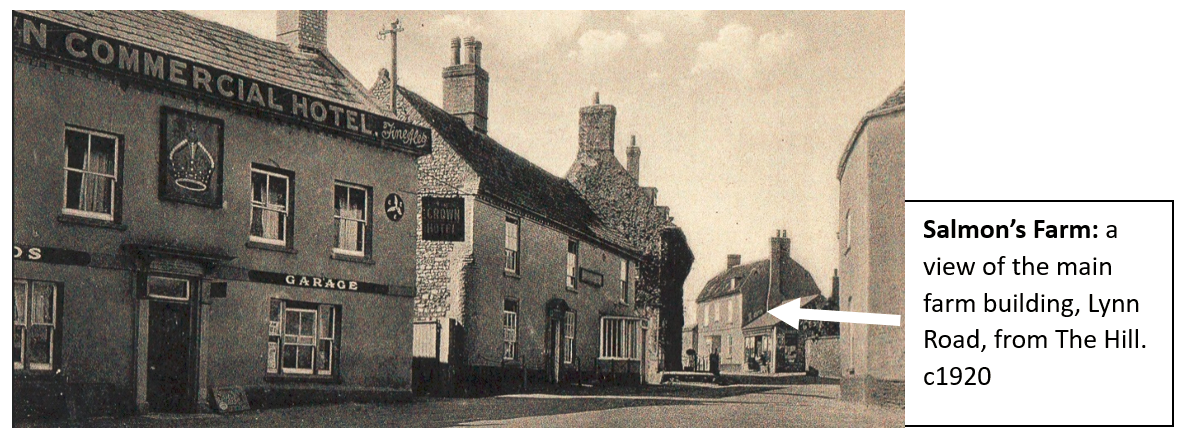
Historically, there were four farms bordering Stoke Ferry: one was at the junction of Oxborough Road and the High Street, where Osbourne House and The Granary and Brewery House now stand; a second was Manor Farm on Wretton Road. A third was on Furlong Road where Kavenham House, The Apiary and Furlong House now stand. The fourth was Salmon’s Farm (ringed below) which occupied the triangle of land bordered by Lynn Road and Furlong Road/ It is now occupied by the Village Hall and land awaiting housing development by Freebridge Housing Association. It is still widely known as ‘Salmon’s Farm’ because for many years it was occupied by the Salmon family, and by Mr. Benjamin Salmon (1829 – 1894) in particular.

Benjamin Salmon’s personal and religious life
Benjamin was baptised in Stoke Ferry on 16th March 1828. He was the second of eight children and the oldest son of George and Susan Salmon. He married Elizabeth Flatman in 1853.1 In 1871 Elizabeth died leaving Benjamin living with his two daughters Alice (13) , Elizabeth (8), his unmarried sister, Emily and his mother, Susan.
Then in December 1874 he married Louisa Thorrold who was the daughter of West Dereham farmers Daniel (d.1869) and Rebecca (d.1876) Thorrold. With Louisa he had two sons, George and Benjamin.
From at least the 1880s, Benjamin played a leading active part in Primitive Methodist meetings at the Ebenezer Free Methodist Chapel which was built in 18602 on Furlong Road, just across from his farm. He also led meetings at the Wretton Primitive Methodist Chapel, including one where he spoke on Temperance and where forty people signed ‘the pledge’. Benjamin frequently allowed the use of the large barn on his farm for evangelistic meetings, gatherings and Sunday School events.
In 1891, Benjamin was widowed again, his son George was living at home and there was a servant named, Susan Bird.
In February 1894 Benjamin was in a serious accident. He and his son were travelling home through Stoke Ferry when his young horse bolted, overturning the trap, “and throwing the occupants with great violence on the ground. The cart fell upon them, and in the fall, Mr Salmon received a severe fracture to the collar bone. He at once journeyed to Wisbech and had it put right.”3 He died just ten months later in November 1894.

Benjamin Salmon: Carrier-Farmer Businesses
Bemjamin’s father is recorded as being a fishmonger – a trade probably involving the use of a horse-drawn waggon enabling him to transport fish from King’s Lynn and sell along the road back to Stoke Ferry. In 1851 Benjamin’s own occupation is recorded as a ‘carrier’; a trade and business he continued and successfully developed throughout his life.

By 1881 Benjamin is described as both a ‘farmer and carrier’, with his farm, consisting of numerous fields throughout the parish, covering 360 acres and employing ten men. His combination of occupations was quite typical of small family carrier firms of the time; travelling no more than a day’s trip of 25 to 30 miles each way and serving regular routes on a fixed schedule, it was such firms that made up the majority of carrying firms in England. That said, setting up a carrier firm required quite an amount of capital and many farmers used their own vehicles to carry their produce into towns to sell at markets, and carry others’ goods back. What is known about Benjamin is that when he died his estate included a substantial number of horses, i.e., “35 cart horses, hackneys and colts”, this gives an indication of the size of the family’s carrier business.

The faint sign on the barn reads “G&B Salmon Carriers”
After their father’s death in 1894, Benjamin’s sons, George and Benjamin, continued the carrying business. However, due to the development of railways and the motorised omnibus. the days of horse-drawn carriages and waggons was drawing to a close.
Origins of Stoke Ferry Village Hall
The Village Hall stands on what was once part of Salmon’s Farm. After World War 1 the building and one adjacent were used by Eastern Counties Bus Company and then by the Ward Brothers’ local transport business – so the tradition of it being used as a ‘carrier’ business continued! In 1926 the site was sold by Thomas, William and Albert Cecil Ward to H. Gordon Parker and several local young businessmen who ran it as a commercial premises for social and sports events. In 1968, the sole remaining shareholder, Favor Parker, sold the premises to the village community for a token payment and the charity which still runs the Hall today was established.
Sources:
- Stoke Ferry, the story of a Norfolk village, Doris E. Coates, Harpsden Press, 1980
- A Farthing for the Ferryman, Richard Coates, The Harpsden Press, 2019
- The Carrying Trade and the First Railways in England, c.1750 – c. 1850, Carolyn Dougherty, University of York, November 2018
- British Newspaper Archive
Footnotes:
- A Rev. Flatman was a non-conformist speaker who spoke to a religious gathering in Benjamin’s barn in 1887. And a Thomas Henry Flatman of Downham Market was an executor of Benjamin’s estate. ↩︎
- The Nonconformist Ebenezer Chapel opened on Furlong Drove in 1860, replacing a Primitive Methodist Chapel situated at an unknown spot elsewhere in the village. From 1834 there was also an orthodox Wesleyan Chapel on Wretton Road which was itself replaced by the Wesleyan Church on the High Street holding its first service on that site in 1903. ↩︎
- Benjamin likely headed to the North Cambridgeshire Hospital, Wisbech which had opened 20 years earlier, in 1873. ↩︎
Explore more buildings in our district with our interactive map.
Leave a Reply