In March, 2019, the Village Pump published an article by Christine Sanderson. It was titled, “How to live and be happy on two acres”.1 This involved the creation of the self-sufficient community. The Methwold Fruit Farm Colony ran from 1898-1917 in what is now called Brookville. The Colony’s families built their own houses, each with a long strip of land. As an experiment it was very much aligned to issues that concern many of us today, i.e.: lack of rural work opportunities; a disconnect between food production and consumption; reducing damage to our planet.
However, this was not the first such attempt to establish a co-operative community in our district. Let’s delve a little deeper….In the 1830s, poverty and disease stalked the land. Many of the rural poor were forced off the land. This was due to the combined effects of the Enclosure Acts and farm mechanisation. There were atrocious conditions for the displaced men, women, and children. They left the countryside to work in the new factory and mill towns of Yorkshire, Lancashire, etc. This brought repeated calls for social reform.

One such call came from Robert Owen (pictured), a wealthy Welsh textile manufacturer and “utopian socialist”. By 1837, Owen had become the “Rational Social Father” of the quasi-religious National Community Friendly Society. The society had over 50 branches across Britain.
That same year, the Society created the “National Community Friendly Society. Its purpose was for “collecting funds for the education of its members and their children, and also for the purchase or rental of land whereupon to erect suitable dwellings or other buildings – wherein the members shall by united Labour support each other under every vicissitude, including the establishment of schools.“
In October, 1838, a deputation was appointed to inspect sites suitable for the establishment of a utopian community. They reported that they had visited a fen farm in the parishes of Wretton, Wereham, and Stoke Ferry.
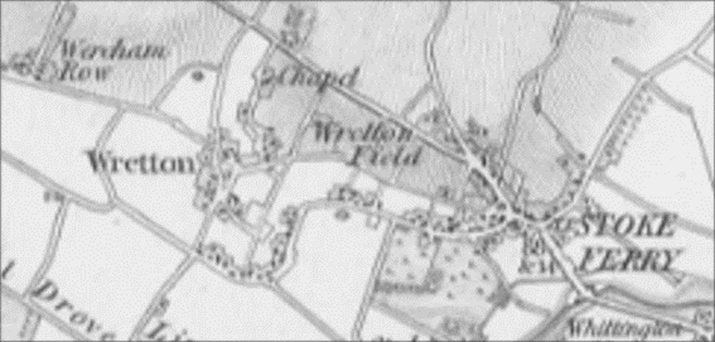
They had entered into an agreement for its purchase and paid a deposit of £1,000 towards the total cost of £11,500 for land owned by James Hill. It was to be Britain’s first ‘Owenite’ community. From contemporary descriptions, it may have covered ‘Wretton Field’ as in the 1824 map below.


However, this ground-breaking scheme was abandoned when the owner of the land, James Hill, a corn merchant and banker of Wisbech, insisted on directing the project himself. He did not want it to be organised through the Society.
Nevertheless, at the same time another attempt to create a farming community met with rather more success. This included a brick-making concern at Manea, near March, Cambridgeshire. It met fierce opposition from the Christian establishment at the University of Cambridge. They labeled the Owenites of both Manea and Wretton “infidels”. This utopian project, led by William Hodson of Upwell, ceased in 1841, after just three years.
~~~~~~~~~~
- An abridged version of Christine’s excellent article, is available at www.stokeferry.com ↩︎
Leave a Reply