
Stoke Ferry and surrounding villages used to be awash with pubs, alehouses, inns and taverns, brewers and maltings.
Here’s a short look at the brewing industry in Stoke Ferry & Whittington; a subject that is especially important at the moment as so many rural pubs across Britain have either closed or face closure.
Hostelries
Hostelries served their local communities but were also drinking, resting, and meeting places on busy market days, and for community meetings, court sessions, rent payments, auctions, Scottish cattle drovers, etc., etc. Known hostelries in Stoke Ferry, with approximate dates, are:
- Bull Inn, Bridge Road (1794-1970s, rebuilt in 1920)
- Blue Bell, Lynn Road (1794-to date)
- Cock Inn, Oxborough Road (c1845-c1950s)
- Crown Hotel, The Hill, (1790-1902)
- Duke’s Head, The Hill (1794-1950s)
- King’s Arms, The Hill (1795-1902, renamed and operated as the Crown, 1902-1939)
- Trowel & Hammer/Shovel & Hammer, now Trowel House, (1846-1932)
- Wounded Heart, location unknown (c1794-?)
- Two beerhouse proprietors appear in Norfolk Directories for 1836 & 1839; James Clarke and Thomas Hewson
- (Source of the above dates: www.norfolkpubs.co.uk)
Brewing
For many centuries Ale, a type of beer brewed without hops, was the staple drink of most people. The yeast in ale needs a moderately warm temperature in order to react with the malt which provides the sugar for the yeast to feed upon, so, back in the day, brewing in Stoke Ferry would have happened mostly in the spring & autumn months. Malt also adds fruity flavours and bitterness.
Beer is 95% water plus a combination of yeast and malt along with hops that act as a preservative. The widespread use of hops began in the 1400s when Lowland brewers came over to England as refugees.
Early brewing in our villages took place in peoples’ homes. It was largely carried out by women ‘brewsters’, who would heat water over their open fire and brew their beer in their kitchens.
Public houses came into existence in the early-1800s. Their predecessors were: Inns which provided lodging and refreshment (such as the Crown); Taverns, which sold wine & food; and, Ale Houses, which provided simple food and ale (and later beer) for the labouring and working class clientele.
At first publicans brewed their own beer, using water from springs on their premises. But gradually their beer came to be supplied and controlled by large family businesses of Common Brewers. By the 1850s beers of the Common Brewers dominated the trade and by this time many of them had had begun to buy up pubs to ensure a market for their wide product range.
Maltings in Stoke Ferry and Whittington
Norfolk was, and still is, famous for producing high-quality grain which was used to create malt. The inland port of Stoke Ferry with its access to King’s Lynn and the wider world made its location ideal for malting. This took place at a number of different sites including: the Crown; The Brewery, Oxborough Road; The Maltings on Bridge Road, on the River Wissey (where The Moorings is now); at Whittington (at the new ‘Maltings’ housing development); as well as at Gooderstone/Oxborough Hythe.
Stoke Ferry Malting
In 1774 the large estate of the bankrupted maltster, Thomas Goddard was auctioned in 36 Lots: “Lot One. …house…with 2 Acres 2 Roods of Land…Malting-Office1 that will steep 26 Quarters of Barley2 every four Days; over this Malting-Office are two Granary Floors, that will hold 800 to 1000 Quarters of Corn…Lot 2. The Bull Inn…and Brewhouse… with a Toll on all Goods or Merchandize passing through the Premises…”. Lots 3-34: Consisted of 197 acres of land, mostly around Little & Great Man’s Way and the “new” Oxborough Road. Also, an orchard, tree plantation, otter holt3, fishery, dwellings, and various businesses, farm leases in Stoke Ferry, Wretton & Wereham, plus a house in Boughton. Lots 35 & 36 were seats No.2 and No. 3 on the “South Side of Stoke Church”. (Source: Ipswich Journal 08.10.1774)
Whittington Maltings
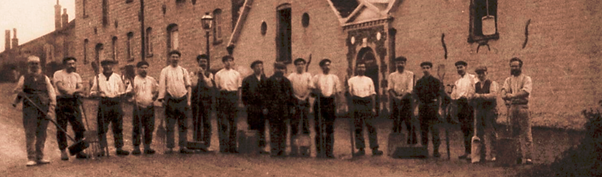
Around 1812 the famous London-based Common Brewer, Whitbread started malting operations at Yarmouth, Southdown, Dereham, King’s Lynn and Whittington. Small-scale maltsters became squeezed out of the market (in 1840 they were thought to account for just 7-13.5% of English malt production). Hence, malting, like brewing itself, became concentrated into the hands of large producers. The present malting buildings in Whittington are thought to date from c. 1822.

Whittington Maltings. Source: Postcard, posted at Brandon in 1909.
See also, the image of Whitbread maltings workers at the head of this posting.

Maltings complex at Whittington c. 1960s Source: Tony Cater, Whittington Facebook page.
Thomas Salmon & Whitbread Maltings
From c180 to the 1830s, Thomas Salmon owned the above maltings along with the Bull Inn on the River Wissey. In 1829, he is described as having “at Stoke four large Mailings of a superior description for Messrs. Whitbread and Co. of London”. The following year he suffered the first of a series of blows when his 17-year-old son drowned in the Wissey. In 1831 another son died of a fever. Later that same year he attended his own bankruptcy hearing in King’s Lynn. As a result his home, malting and the Bull Inn, estimated to be worth £5,000, was advertised for sale. The description included; “Adjoining the House is a capital Malt-house in complete order, capable wetting 50 quarters every fourth morning, the kiln is 28 feet by 24 feet, with spacious store-rooms for barley and malt…Also…a spacious Wharf, upon which is a Malt-house 20 quarters steep”. In July 1834 he advertised his services “as Clerk, Correspondent, Superintendent, or Agent…”. He moved to Stanground, Huntingdonshire where his wife, Elizabeth died and in 1836.

1906 Map of Whittington
Samuel Taylor & Whittington Maltings
Samuel was the manager of the Whitbread Malting concern between 1830s-1847. It is possible that he took over this position from the above Thomas Salmon.
As a supporter of the Whig Party Samuel had very different political views from other local businessmen/landowners who supported the Tory Party. He was a prolific newspaper letter writer on subjects from the Corn Laws to threshing machines to efficient turnip growing. He established a wire fence manufactory in Whittington. Samuel joined with other local merchants, maltsters and millers to attend the Friday grain market on Market Hill, for the purpose of buying Corn. He was a member of the Stoke Ferry Association for Prosecuting Felons which offered £5 for information when Samuel’s home was burgled in 1839. In 1840 he was elected President of the Farmer’s Club which he himself established to modernise local farming practices. His 1847 farewell dinner at the Crown Inn was attended by some 50 local businessmen and landowners. At the same event three men named Childs were mentioned as having come from Bungay, Suffolk to assist Mr Taylor’s work at the Maltings.
Footnotes:
- Office: Here ‘Office’ denotes a separate building where a specific task, e.g. malting, takes place. ↩︎
- ‘Quarter’ is an old measure for barley as bought by a maltster. It equates to one-fifth of a ton, i.e. 448 lb (203Kg), which would yield approximately 80-100 lb (36-45Kg) of malt extract for the brewer ↩︎
- An otter’s den is called a holt or couch. Presumably this otter den at The Bull Inn on the River Wissey was used to breed otters for hunting. A source of interesting otter hunting terms can be found here ↩︎
3 responses to “Pubs, Brewing & Malting in Stoke Ferry & Whittington”
-
I remember having a drink brought out from the servery in the Dukes Head in the early 1970s. I was served by Mary Carter of Boughton.
-
I also have a 1826 Bryant map showing the maltings
-
Hi, that’s interesting….is it the same map as the one at https://stokeferrydhg.org/maps-stoke-ferry-wretton-whittington/ ?
-


Leave a Reply to Jim McNeillCancel reply