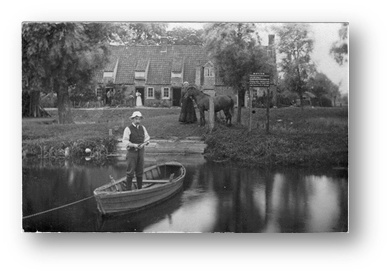
Just over a mile directly south-west of Oxborough village there used to be a popular ferry. It was used for crossing the river Wissey. It was just south of Oxborough Hythe (or Hith), meaning a landing place.

Today, little remains of what was a busy crossing point linking Oxborough with the main Lynn to Thetford Road. Information on the Ferry and the Hythe is sketchy at best. But here are some of the references put together with the help of Barbara Pritchard of the Oxborough History Group.
About half a mile from Oxburgh Hall, Ferry Road leads off to the left. It gradually peters out into a green lane. which finishes abruptly at the river’s edge. A similar lane, leading to Whittington, can be discerned on the opposite side of the river. But the cottages that were once grouped at the ferry’s river edge are long gone. WW2 prisoners of war demolished them.

In 1976, Fred Greef of Oxborough, described the ferry as a flat-bottomed raft, self-operated by chains. It was large enough to take a horse and cart. He recalls the story of one man. The man walked backwards, holding his horse’s bridle as he manoeuvred his cart onto the ferry. He went straight over the edge into the river. Fred also recalled the ferry being towed all the way to Denver to be repaired. They faced great difficulty towing it back to Oxborough because of the river’s current. His last image of the ferry was seeing parts of it lying on the riverbed.Mrs. M. Mouncer of 74 Fir Close, Mundford, remembered paying a penny to cross the ferry. It was one of the “treats” she enjoyed. She thought the ferry was still operating in 1916.1

Back in time: The Domesday Book of 1086, described the River Wissey as being navigable from “Oxenburgh” to King’s Lynn and Cambridge. The detail of the 1725 map opposite,2 shows the house at the Ferry as The Hith House. Its foundations are still to be seen, though very overgrown. By the 1750s, there were wharfs nearby. These were possibly at the end of the road shown as leading west from The Hith House. They were used for the handling of coal and grain.
On July 8, 1780, the Norfolk Chronicle had the following notice:
“EDWARD SQUIRE hereby informs his Friends, and the Public, that the best COALS may be had at Stoke-Bridge, and Oxborough-Hythe, for ready Money, at One Pound Nine Shillings per Chaldron, every Expense included.”
On May 22, 1813, the Chronicle carried a further notice:
“NORTHWOLD ESTATES, ALL FREEHOLD .- LAND-TAX REDEEMED, to be sold by auction, By Mr. Burt, on Friday, the 28th day of May, 1813, at three o’clock in the afternoon, at the Crown Inn, at Stoke ferry [sic] … Lot 3.- A Piece of Arable Land, containing 23A. 2R. 10P. adjoining to the public road leading from Oxborough Ferry to Methwold, now in the occupation of Joseph Bennett and George Bennett, under a lease which will expire at Michaelmas, 1819, at the apportioned annual rent of 20L [£20]”
According to Richard Coates, during the 1800s the malting industries at Stoke Ferry and neighbouring Whittington and Oxborough Hythe were established. This increased waterborne traffic on the River Wissey.3

A tranquil day at Oxborough Ferry c1910, showing the now demolished cottages. From the postcard collection of Janet Taylor, Stoke Ferry.
Trade itself continued at the Oxborough Hithe wharf, until at least 1858. And The Wissey, a commercial barge operated by J Coston of Hilgay, reached Cambridge in 1896. It also reached Cambridge in 1898. So it will have passed by, or perhaps called in at, Oxborough Hythe.
The Lynn News of 10 January 1930 carried an interesting account of Albert Carter of Oxborough Ferry. Albert had joined the police force at 20 years of age;
“At the annual dinner and concert off “B” Division of the City of London police, held at Snow Hill police station on Jan. 3, five ex-members of the division who had retired during the year were among the principle guests. Among them was ex-P.s. [ex-Police Sergeant] Albert Carter, who was born at Oxborough Ferry. Mr. Carter, who had completed 27 years and five months’ service, was presented with a gold watch, and an ivory-handled umbrella for his wife. The son of the late Mr Walter Carter, who was for many years farm steward to the late Mr Gates Green, Mr Albert Carter received his education at Hewars School, Oxborough. He informs us that at one period, out of a total population of 122, 11 villagers were serving in various police-forces throughout the kingdom. Mr. Carter was present at the Sidney-st siege in 1911.4 He possesses the King Edward and the King George coronation medals.”
On 21 January, 1938, the Lynn Advertiser had the following death announcement; “In London, on Jan. 14th. Albert Carter, formally of Oxborough Ferry, Norfolk. Aged 55.”

More recently, on 15 June, 1976, the Lynn News & Advertiser carried the following advertisement: “COUNTRYSIDE TRAIL FERRY FARM, OXBOROUGH Turn down Ferry Road at N.C.C. signpost marked Oxborough Ferry No Through Road. Approx. 1 ¼ mile walk across flora rich pasture, through woodland and along the bank of the River Wissey. See the birds, flowers, goats and crops. Feed the ducks. Picnic glades – Information centre. Open Wednesdays, Thursdays and Sundays. 1-6 pm. Admission by Trail Guide 20p No Dogs allowed There is an alternative shorter walk.”
Finally, in March 2005, the Northwold & Whittington Village Life magazine published a letter from Roger Warner of Grange Farm, Whittington. He asked if anyone knows anything about the Oxborough Ferry. He believed it consisted of “a wooden platform fixed to a chain enabling users to pull themselves across the river. It was capable of carrying a pony and trap. People living south of the River Wissey used it to get their persons and produce to Oxborough, Gooderstone, and Swaffham.“
Footnotes:
- Both reminiscences are from The Lynn Advertiser, 05 March, 1976. ↩︎
- 1725, de Wilstar map (Norfolk Record Office. Ref; BRA 2524/2) ↩︎
- A Farthing for the Ferryman, Richard Coates, The Harpsden Press, 2019, p 61. ↩︎
- The Sidney Street Siege, January, 1911. This was an armed standoff in London’s East End between the police and army, and two Latvian revolutionaries. Three policemen were killed during the siege and two others were wounded. George Gardstein, the leader of the Latvians, was also killed. ↩︎
Leave a Reply