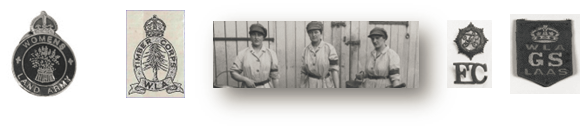

It is useful to reflect on the role women played by doing ‘men’s work’ during World War One. Their experiences changed the position of women in England’s post war society. In this post, we look at the work women did on the land. We include an example from the Sandringham Estate.
In late-1916/early-1917 there were calls for the Women’s Land Army to be formed. Nearly seven thousand women were already working on the land. This call was for their number to be formalised and doubled through recruitment of new Battalions. Recruitment would take place at centres based across the nation’s Post Offices and Employment Exchanges.
Women were needed to replace the men. These men had been lent by the army to farmers for the 1917 spring planting. But there were other factors at play. All armies on the Western Front were now involved in materialschlacht. It was a war not of morale will or manpower. It was a war of sheer industrial material might. This is highlighted by the fact that 60-70% of casualties in the First World War were caused by artillery machines. Part of this industrialisation of warfare can be found close to home. In early 1916, a corner of Elveden estate was sealed off to test a new industrial weapon: the tank.
Over one million men had enlisted by January 1915. But this was not enough to keep pace with mounting casualties. In 1916 Military Service Acts were passed imposing conscription on all single men and married men aged 18 to 41. In 1918, the Act raised the age limit to 51. This led to a crisis in labour for jobs that were traditionally done by men, this included farm labour.
By October 1917 there were 6,000 women of the Land Army at work in Norfolk. Once enrolled they were called War Land Workers. Individual women could be recommended to become a Group Leader. This was a position with a higher pay grade. Leaders could also be promoted to the position of Instructor. Also, “Selected members who wished, after the war, to farm on their own account and to form themselves into groups for this purpose will be separately registered, and every effort will be made to secure for them special facilities for settlement on the land either at home or in the Dominions overseas.”
There were three sections in the Women’s Land Army:
Agricultural Section: By autumn 1918, this section had 12,649 members. Most were employed as milkers or field hands. Other occupations included bailiffs, tractor drivers, thatchers, ploughwomen, and working in private gardens.
The Women’s Forestry Corps employed gangs of women to carry out forestry work. By January 1918, 400 women worked as foresters, including in Thetford Forrest.
Forage Corps (haymaking for food for horses): 8,000 women were working in this section by the end of 1919.
There were instances where a number of farmers would have stopped producing food entirely. This was avoided by the use of women workers. In some cases farms were run entirely by women.

Recruits could enrol for 6 months and be sent straight to farms, or, after a period of 6 weeks training, enrol for a full year’s service. Those wishing to work for the Forage Section on hay-baling machines signed on for 12 months.
Recruits were supplied with a outfit consisting of breeches, leggings, clogs, a hat and two smocks. A mackintosh and jersey were provided in the wintertime. The minimum weekly wage for an untrained Land Worker was £1. For one who had passed her efficiency test her wage was 22 shillings. Lodgings were found before the women went to their post. The price of their accommodation was deducted from their wage along with the cost of their food.

Thus, free of family restraints and with what was left of their pay, these women gained a certain amount of independence. They also had leisure time off from work to attend the cinema, events, dances, etc. A letter dated 4 July, 1918, to the Food Production Department, Board of Agriculture & Fisheries, from the Monmouthshire War Agricultural Ladies Committee, casts an interesting light on the experiences of the liberated ‘Land Girls’:
“…concerns regarding the behaviour of some of the recruits to the Women’s Land Army and the general behaviour when off duty. They stay out late and often do not return to their Farm until 12 or one in the morning and this is a constant occurrence if they are in distance of a town, and naturally they are very much talked about. The girls themselves, with few exceptions, do the least possible work they can, and knowing that their hours are fixed, they never if they can help it oblige by working late…We have had cases lately of the girls running away from the training centres after working two or three days also of girls leaving the farm [to return home]…”
Early Women Land Workers at the Sandringham Estate.
In Spring of 1916, a year before the formation of the Women’s Land Army, Phyllis and Hilda Hobson of London, and their cousin Marjorie Maxfield of Sheffield (see pictures below) were recruited to work on the King’s Estate, Norfolk. They were based in the nearby village of Wolferton. The Sandringham women had been trained on a farm school at Lydney, Gloucestershire. When they went to Wolferton they lived in a cottage under the care of Marjorie’s mother. Their work was strenuous – up at six and often not completing work until it was dark. They must have been amongst the first women in the country to be employed in this kind of work.

The Sandringham women had been trained on a farm school at Lydney, Gloucestershire. When they went to Wolferton they lived in a cottage under the care of Marjorie’s mother. Their work was strenuous – up at six and often not completing work until it was dark. They must have been amongst the first women in the country to be employed in this kind of work. In November 1916 there was a great deal of press interest. A newsreel showed them in action to “encourage other girls to work on the land”.

Once the war was over, women were no longer recruited for land work or other occupations such as munition workers. But wartime had given many young women a taste of social independence and when they returned to the employment sector they came as wage-earners with an entitlement to leisure time. They exhibited an assertiveness and an inability to know their place. Those who were willing to go back to more traditional occupations, such as servants or housekeepers, frequently they did so on their own terms. Traditionally domestic service employment was residential and involved low wages and long hours. The women demand shorter and fixed hours of work; more days or half-days off; higher wages; the exclusion of the mistress from her own kitchen; and the abolition of the cap (seen by the women as a “badge of slavery”). In Rural areas such as ours, women often returned to domestic service due to the lack of alternative occupations. However, new opportunities were on the horizon for some, as can be seen in this Norwich Mercury headline from November 1919, “Dearth of teachers. Should women be employed?”
In 1918 a coalition government passed the Representation of the People Act, enfranchising all women over the age of 30 who met minimum property qualifications. Times were certainly changing.
PS. As an adjunct to the Sandringham story; in 1924, a Miss F. M. Watson was appointed as Manager of the King’s dairy at Balmoral. It goes to show that sometimes change has to come from the top!
Sources used:
- Cambridge Daily News, 11 April 1917, and 30 October 1917
- Farringdon Advertiser and Vale of the White Horse Gazette, 20 July 1918
- Country Life Magazine, 11th November 1916
- Young Women, Work, and Family in England 1918–1950, Selina Todd, Oxford University Press, 2005
- Sandringham Women Land-workers:
- Women’s Land Army, www.womenslandarmy.co.uk
- The National Archives, https://discovery.nationalarchives.gov.uk
Leave a Reply