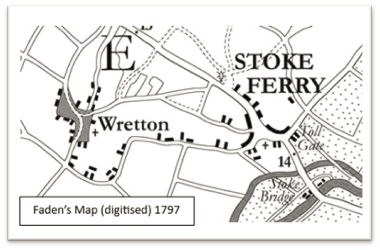
The small village of Wretton was once described by a local historian as a fen-edge development, and it is clear to see even today that it is. The area has been inhabited for thousands of years, demonstrated by the finding of a 10,000 year old auroch skull in 1981. A well-known paleontologist/geologist, Tim Holt-Wilson, referred to the area where the Cut-Off channel is as a perfect site in which early man once lived, with an abundance of food sources available.
Wretton’s older cottages are situated alongside small roads leading either towards Stoke Ferry or towards Wereham, with the Stoke Ferry/Wretton Common opposite. There is barely a nucleus, and that is dominated by All Saints Church. Wretton has always really been a hamlet, often attached in some way to the larger villages of Wereham or Stoke Ferry. In the Domesday Book, Stoke Ferry is described as having 1 ¼ churches, the ¼ thought to be the church of All Saints.

Wretton has never had its own manor, being attached to the Manor of Cavenham at Wereham, although White’s Directory of 1845 reports that the Lord of the Manor is Roger Micklefield of Stoke Ferry and the village’s land is mostly held by him or by J B S Bradfield, also of Stoke Ferry. Consequently, there is no Manor House although some old documents refer to an Irun Hall, thought to have been situated off Chequers Lane, thus bordering on Wereham land.
Wretton villagers were always farmers or farm labourers. There are two large farmhouses – Manor Farm and Church Farm – the former an older building with adjacent large barn, once the Tithe Barn (now converted into two dwellings). Neither is now a working farm. Additionally, there were two smaller farms – Fairview Farm and Harringay Farm, both also private dwellings. With little workable stone in the area, most of the older buildings, including to some extent, the church, are built of flint and rubble.
The church demonstrates three sources of local building material, with the chancel being constructed of Carstone, quarried from the lower Cretaceous beds which are near the surface locally. (Interestingly, some gravel from Crimplesham quarry, often has pieces of fossilised belemnites, an ancient squid-like creature from that period!). The nave of the church is built of mostly ironbound conglomerate which is an ironstone with bits of flint embedded in it. It is thought to have been found near the surface and would have been removed by local farmers in order not to break the ploughs. The tower not only has a very interesting ‘insert’ of knapped flint about halfway up, but its base is older than the rest, possibly an indicator of older foundations. Like my own house, the church too has one or two pieces of worked ashlar stone, which I suspect may have been acquired from fields around the destroyed West Dereham Abbey. Finally, clearly the porch is a Tudor addition, like some of the square topped windows. The porch has some lovely diaper-work, i.e. decorative diamond shapes in black flint.
All of the land on the river side is still owned by the Crouch family, after H O Crouch bought 1,600 acres in 1938. There still exists a large dwelling called Wretton Fen House although the current building was once a row of cottages and the original being further down towards the River Wissey. Other land, particularly towards West Dereham, is farmed by the Glover family of West Dereham. However, there are a few pieces of Charity land, belonging to the Jane Forby Trust, established by the said lady of Fincham in 1711. The income from this Trust is used to provide a small financial gift annually at Christmas to the poor, needy or elderly of the parish.
Wretton was once served by the Downham to Stoke Ferry Railway, with two railway crossings and crossing keepers’ cottages. These exist still as private dwellings but the track is long gone. The railway closed in the 1930s as a means of public transport. I have a photo which shows villagers standing in front of carriages waiting to take them on an outing to the seaside, probably Hunstanton, as evidenced by a spade held by a child. The railway continued as a goods line for some time after. I remember hearing the train hoot as it approached the level crossing on Limehouse Drove in Stoke Ferry, around 3pm each day, when I was a pupil at the old primary school.

Wretton once had a school (right), a Methodist chapel (next door) and a shop/post office, as well as 2 public houses and a couple of unofficial beer retailers. The School is now a private dwelling, as is the Post Office/Shop, with a row of bungalows replacing the site of the chapel. An old photo dated around 1945 shows 45 pupils, with Mrs Cresswell, headteacher, and Miss Wadsley, assistant teacher. The School closed in the late 1950s, and I remember less than a dozen pupils joining me at Stoke Ferry Primary. The shop closed in 2003. I remember, as a child, visiting my grandpop, who lived in the cottage we live in now, and going to the shop, then run by Mr and Mrs Scott. The last postmistress was Pauline Sprules. The Post Office is pictured in 1965.

Today there is a bit of a buzz around Wretton with a young and proactive group of Parish Councillors, and a strong Church community that holds a coffee morning on the first Saturday of each month, using the church’s facilities of a community area, kitchen and toilet. The church thus serves as the community’s village hall as there has never been a dedicated village hall although the school building, once closed, was used as such for a while.
Helaine Wyett.
Committee Member, The Stoke Ferry & District History Group
Leave a Reply