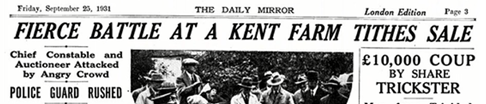

What were Tithes? Tithes were originally paid to the local church body. They represented a tenth of the annual increase of the produce of the soil. There were three kinds of Tithes:
- Predial Tithes, payable on ‘fruits of the earth’, such as corn, hay, wood, fruit.
- Mixed Tithes, payable on animal products, e.g., lambs, calves, wool, milk, eggs, honey.
- Personal Tithes, payable on the gains of a person’s labour and industry. These were generally levied on the profits of milling and fishing.
In England and Wales, the Rector of a parish received the income from Tithes. A Rector might be a resident incumbent, a bishop, prior, prioress, monastery, nunnery, or a college. An absentee rector appointed a vicar and allotted to him a portion of the revenues. This was usually the Small Tithes. This included all Tithes except for grain, hay, and wood, which constituted the Great Tithes.

Tithes were established in Europe in the 8th century. They were a major source of subsidy for the construction of many of the magnificent cathedrals across the continent. The right to receive tithes was granted to English churches by King Ethelwulf in 855. In the 10th century a law was introduced to impose penalties for non-payment. Tithes were an important factor in both the English Peasants Revolt of 1381 and Germany’s Peasant Wars of 1524-25.
1536-41 saw Henry VIII’s dissolution of the monasteries. During this time, Catholic church land was passed to the Crown. The Crown then sold it to private landowners, along with its Tithe tax revenue. For example, the Manor of Cavenham was granted to the Bedingfelds of Oxburgh. They received it along with the Great Tithes for Stoke Ferry & Wereham. These Great Tithes remained in the Bedingfeld family until about 1718. They were then sold to Edward Nightingale of Kneesworth, Cambridgeshire. By 1840 private Tithe-owners, known as lay impropriators, held around a quarter of all Tithes in England & Wales.
In 1703, Queen Anne’s Bounty1 was established by Parliament. This gave the Church of England the right to receive farmers’ produce. Various institutions, such as Oxford and Cambridge University colleges, major public schools, and hospitals like Guy’s and Saint Bart’s in London, also had this right. They could collect “in Perpetuity the Revenues of the First Fruits and Tenths” of farmers’ produce. That is, farmers and peasants – of whatever religious belief or none – had by law to give one tenth (or its cash equivalent) of its produce every year. Over the next two centuries, the Tithe laws became an increasing cause of resentment.
From the 1750s, Enclosure Acts2 made significant modifications to the Tithing system. This happened by either doing away with (“extinguishing”) in kind Tithe payments altogether. Alternatively, it was through a one-off payment. These could also be replaced with annual monetary payments.
Tithes were an important aspect of the Enclosure legal process under which rights to common land were radically reduced and ‘open field’ farming practices ended. Through the allocation of land to local churches perhaps 60% of Enclosure Acts involved the Commutation of Tithes. By this means, in the period 1750 to 1830, Glebe land increased. Resulting in clerics in some places became active farmers and landlords. The shrinking of the land owned by the peasantry substantially alienated them from the Church of England. It brought about a devastating disruption to established ways of life in rural England.
By the early 19th century there was fierce opposition to Tithes. This was known as the Swing Riots. Protesters, dispossessed cottagers, labourers and peasants, wanted Tithes abolished so farm employers could pay them higher wages. At the other end of the social scale, Tithe payments in kind held little attraction for the new class of capitalist farmers who were benefiting from Enclosure, mechanisation, and drainage schemes. To large landowners and farmers, Tithes posed a barrier to agricultural modernisation. Any profit from improvement was likely small because of higher Tithe payments. Potential investors in new schemes were also deterred from venturing their capital because of attendant increased Tithe payments.
Rural unrest and lobbying by farmers and landowners led to significant change. As a result, the Tithe Commutation Act was passed in 1836. This required Tithes in kind to be converted to monetary payments called Tithe Rent Charges.
In 1838, in accordance with the new Act, G. R. Eyres, late of Cavenham Hall, was the Impropriate Rector and owner of the Great Tithes of Wereham and Stoke Ferry. He called a meeting of local landowners and Tithe-owners on 17th September.
His announcement was followed by a request for a separate meeting on 22nd October. This second meeting was called by the major landowners in Stoke Ferry; J. B. S. Bradfield, John Wright, William Newton, Anthony Etheridge, W. Hebgin, Richard Lucas, and Roger Micklefield. These men collaborated with William Blamire and Richard Jones. They were the district’s two Tithe Commissioners. Their task was to survey, value, and assess the state of cultivation in the parish of Stoke Ferry. The survey, its detailed maps, along with evidence of who owned which plots of land and the rate of cash Tithe payment for each plot was quickly achieved. The details were put on public display and eventually agreed by all parties involved.
1848: As a result of the Act All Saints Church had, in this year an annual income of £100, plus the commuted Great Tithes of £247, and Small Tithes of £227. 9. 0d. By 1904 its Great Tithes belonged to the Norwich Union Fire Insurance Company.
The Agricultural Act of 1920 laid down above average prices paid to farmers for wheat and oats based upon high 1919 prices. This led to an automatic increase in the value of agricultural land. Under the same Act, landowners were not allowed to raise the rents of their tenants. Estate owners, under financial pressure from death duties, etc., realised that they’d be better off selling their farmlands at top prices to their tenants. The result was many thousands of tenants borrowing money from banks to buy their own farms. This led to one tenth of all land exchanging hands and an estimated increase of some 45% of new owner-occupiers.
Now, what these new owners were not really aware of was that as tenants they did not have to pay Queen Anne’s Bounty, but as land owners they did! When the Corn Act of 1921 removed government financial support for agriculture, these new owner-farmers were left stranded. They faced such acute financial difficulties and bankruptcy. The land under cultivation in Britain shrunk by a quarter, from twelve million acres to just nine.
The Tithe War of 1920s-1936
Much productive land in East Anglia had fixed Tithes of 7/6d (37p) to 10/- (50p) per acre. A significant sum in those days when many farmers were losing money and farmworkers were paid about 25/- (£1.25p) a week. This combination of dire circumstances led to the ‘Tithe War’.

Farmers and supporters at a rally in Hyde Park
This ‘war’ was a bitter dispute between small farmers and the Church of England. It was the culmination of a longstanding dispute concerning Queen Anne’s Bounty. Farmers were increasingly angry about a tax they could ill afford to pay, particularly during this period of economic depression. Several thousands of Tithe-paying farmers and landowners were having their lives and livelihoods ruined by the Church.
Many smallholders had moved into the countryside after the First World War, when other employment was hard to come by. This new breed of farmer was often not religious and found it shocking that they were required to give substantial sums to support the livings3 of local Anglican clergymen. Small farmers faced with debt and bankruptcy could not pay what they owed Queen Anne’s Bounty. When they could not or would not pay, then bailiffs4 were sent to distrain goods and property to the value of what was owed. These goods were then put up for auction. This happened on numerous farms in East Anglia and elsewhere in the country. However, the farmers soon organised themselves into Associations (as did the clergy and other Tithe-holders). When a farm refused to pay Tithes, there was a distraint auction. Farmers gathered from around to bid for animals and goods at ridiculously low prices. They did this so they could return them to the original farm. In response to this however, Queen Anne’s Bounty took on a tougher approach. They sold animals and goods from Anglia and the south in the north of England. However, so well organised were the farmers that, by 1934, their “passive resistance” was successful. With 8,000 distraint orders waiting to go through the courts they managed to totally clog up the British legal system.
The stand-off led to compromise and the passing of the 1936 Tithe Act. Under this Act the state bought out Tithe-owners with Government Bonds, so they had a regular income. Tithe-payers paid a reduced charge collected not by the church but by the Inland Revenue. But still the dispute rumbled on until, in 1976, the Labour Government announced the end to all Tithe redemption annuities. Finally, after 1,100 years Tithes were no longer in existence; they had been “extinguished”.
Footnotes:
- In 2022 Church Commissioners reported that Queen Anne’s Bounty had invested significant sums in the South Sea Company. The Company, which transported 34,000 slaves to the Spanish Americas, had received donations from people with links to slavery, including Edward Colston. ↩︎
- The Enclosure Act for Stoke Ferry, Wretton, Wereham and Winnold was passed in 1815. ↩︎
- Livings: A guaranteed income and home for the lifetime for an appointed clergyman, such a position was considered a suitable position for younger sons of gentlemen. The masters and fellows of Gonville and Caius College, Cambridge (both receivers of Tithes) decided on several local living appointments, including: Denver, Weeting, Wilton & Hockwold, Oxborough Rectory and Foulden Vicarage. ↩︎
- Queen Anne’s Bounty Bailiffs were called “possession men”. They guarded possessed cattle, etc. Stand-offs with farmers were common. The Bailiffs were mainly unemployed, ex-service men working for a company set up to break the farmers resolve; General Dealers who worked out of an office in a London hotel. ↩︎
Leave a Reply