

As a Member of the Pharmaceutical Society, Ernest Lionel Hinde MPS lived and ran his business on the High Street, Stoke Ferry in the first half of the 20th Century. His shop (right) was already a chemist’s (1) and was quite large; carrstone faced with plate glass windows and his name ‘HINDE’ above the entrance doorway. Above this was a larger, now sadly lost, sign painted onto a bricked-in window: ‘HINDE CHEMIST, STATIONER and TOBACONIST’.

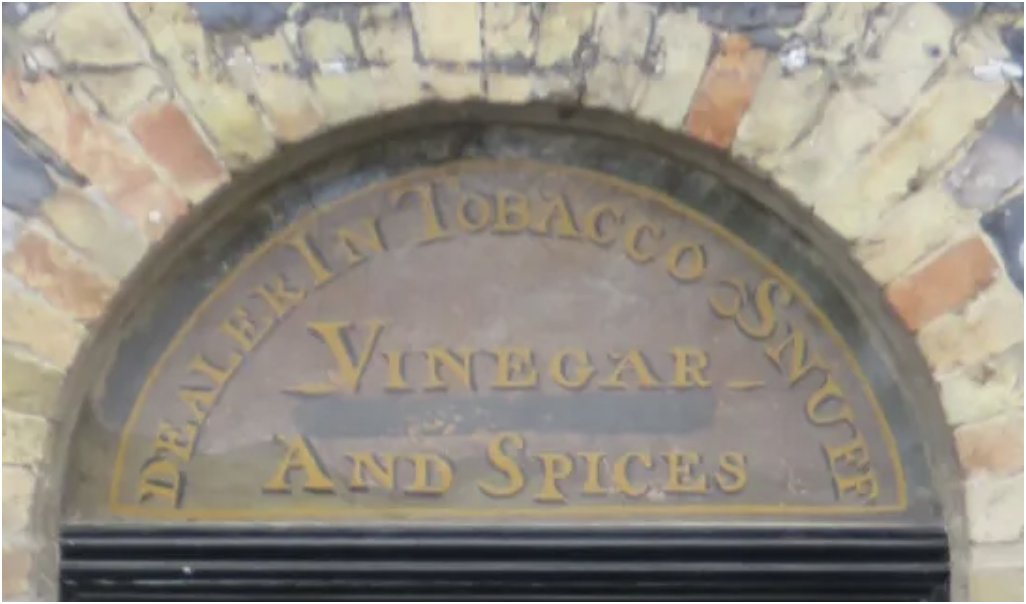
Mr Hinde’s business seems to have changed over the years (see below) as he tried providing various services including; hairdressing, seedman, wine merchant, stationer and fancy goods dealer. His service as a hairdresser was rather common for chemists who often produced their own lines in toiletries, perfumes, lipsticks, hair dyes, etc., though Ernest may have bought in such items from elsewhere.


Ernest’s shop would have had racks of medicine bottles graduated in half-fluid ounces, drawers full of corks of many different sizes, a powder folder, a pill machine, sets of apothecaries weights and racks of white wrapping paper for powdered medicines, with the red sealing-wax waiting to be used, or, perhaps a pill-making machine.
So, what was his relationship with others in the village and the surrounding area?
Until he retired in 1928, the village doctor was Henry Frederick Steele who lived in The Lodge; directly behind Mr Hinde’s chemist shop. (2) One imagines that he and any other local doctors would have used Ernest Hide as a source of medical supplies, at least from time to time.
Of course, local people will have used Mr Hinde’s pharmacy. In the earliest years of the 1900s over 90 per cent of doctors’ prescriptions were dispensed by the doctors themselves or by their staff. Then the National Insurance Act of 1911 brought around 14 million employed persons into a scheme which required general practitioners to write prescriptions for patients who were covered by the scheme. Consequently, patients from January 1913, just as now, were able to present their prescriptions at the pharmacy of their choice. This must have brought increased trade to Ernest Hide for, as The Pharmaceutical Journal, remarked, “the business of pharmacy entered upon a new era”.
Another local connection was Harry William Harold. Harry Harold, was Stoke Ferry’s prolific professional photographer and a near neighbour of Ernest Hinde. Harry must surly have bought his photographic chemicals through Ernest. Certainly, they collaborated in producing a series of stunning postcards of Stoke Ferry and the surrounding district under the brand name of ‘Hinde’s Series’. This activity will have complimented Ernest Hinde’s early business development as a stationer.


Ernest was certainly part of the village fabric as these clippings below clearly show. The one from 1905 shows that both he and Harry Harold were supporters, and probable members, of the Tory and Unionist Party. (Thomas Hare MP who was present at a Stoke Ferry Village Hall meeting in 1905, was the long-standing Conservative MP and went on to lose his seat to the Liberals the following year).

And so, to Ernest Hinde’s drug dealing scandal.…but first a little background on the opium involved (Laudanum) and the changing laws of the land.
Laudanum is made by dissolving opium in alcohol and was first introduced by a Swiss physician, Paracelsus, in the 16th century. Thomas Sydenham, a celebrated 17th century doctor, had a recipe that contained “one pint of sherry wine, two ounces of good-quality Indian or Egyptian opium, one of saffron, a cinnamon stick and a clove, both powdered”. In others, fruit juice, sugar, spices and opium were fermented into an alcoholic syrup.
In fact, “Opium, and after 1820, morphine, was mixed with everything imaginable: mercury, hashish, cayenne pepper, ether, chloroform, belladonna, whiskey, wine and brandy.” (3) In the 19th century it became a very popular treatment for a very wide variety of ailments, and particularly as a painkiller. The taking of opium has long history in our Eastern region. In the early 19th Century, travelers to Norfolk were warned to treat their pint in the pub with caution as their beer could be laced with opium to ward off the malaria that flourished in the Fens. On December 26, 1850, the Morning Chronicle referred to the “opium-eating city of Ely” (see extract below). Yet you didn’t need to go to some back

street or drug den to score a hit: opium was available without restriction or any kind of prescription at your local chemist and druggist’s. It was possible to walk into a chemist, such as the one in Stoke Ferry, and buy not only opium and cocaine, but also arsenic. Even Mrs Beeton’s famous Household Management contains recipes for opium-based remedies!
So, at the time Ernest Hinde was setting up in Stoke Ferry as a chemist and druggist, opium, laudanum and, opium-based patent medicines were widely available to his clientele. The most popular patent medicine was Godfrey’s Cordial, advertised as “efficacious in most of the complaints incidental to young children”. It was recommended for soothing babies to stop them crying, and “if the mother of an infant takes an occasional dose, … she will find it most beneficial both to herself and child”. It became infamous for causing the deaths of young babies. Overdoses were not uncommon and some infants dying of malnutrition, because they were too drowsy to feed.
From 1914 onward, in post First World War Stoke Ferry, there will have been a demand for affordable pain killers from returning injured and traumatised soldiers to soothe their inner and outer pain.
But all this practice ended when the UK’s Dangerous Drugs Act, 1920, changed drug addiction to a penal offence which up to then was, within the medical profession, treated as a disease. The costly ‘War on Drugs’ had started and who was the first person in Norfolk to fall foul of this new Act? Why, none other than our very own, Ernest Lionel Hinde, who, for what ever reason, financial and/or medical, was up before Downham Market’s courthouse in 1923….
From; THE CHEMIST AND DRUGGIST, June 2, 1923.

Legal Reports: Irregular Sale of Laudanum. — At Downham Market, on May 28, Ernest Lionel Hinde, chemist and druggist, Stoke Ferry, was summoned under the Dangerous Drugs Act, 1920, for having supplied laudanum to Morley Thomas Croot, Colin Mackenzie, and Victor George Eugene Manders, who had no licenses. Croot and Manders were also summoned for aiding and abetting Mr. Hinde. All the defendants pleaded ” Guilty.” Mr. D. Jackson, who appeared for Mr. Hinde, said it was a purely technical offence, as Mr. Hinde did not realise that the Act was in force. It was the first prosecution of the kind in Norfolk, and he suggested the case might be dismissed on payment of costs. The other defendants were quite ignorant of the Regulations. Mr. H. G. Lemmon, who appeared for Croot, said the case exhibited very clearly the difficulties of legislation by Regulations. These Regulations were not accessible to everybody. The Act was aimed at the more dangerous drugs. He supposed that if anyone suffered from toothache, he would have to apply to the superintendent of police for a certificate. The object of the prosecution would be fully met by the publicity that would be given to the proceedings. Mr. Hinde was fined 2s. 6d. in each case, with costs, making 27s. 2d. in all. The cases against the other defendants were dismissed.
(1) The building was once owned and rented by local, wealthy landowner Roger Micklefield. In 1833 his tenant was Mr Piggott, also a druggist. Much of the Micklefield’s family estate was auctioned off in 1920; perhaps Mr Hinde bought the shop premises or, perhaps he acquired a new landlord. Source: A Farthing for the Ferryman, Richard L. Coates, The Harpsden Press, 2019, p172 & pp176-178.
(2) Source: A Farthing for the Ferryman, Richard L. Coates, The Harpsden Press, 2019, , p212.
(3) In the Arms of Morpheus: The Tragic History of Laudanum, Morphine, and Patent Medicines”, by Barbara Hodgson. Buffalo, New York: Firefly Books, 2001, page 104.
Explore more buildings in our district with our interactive map.
2 responses to “Ernest Lionel Hinde, Stoke Ferry’s Chemist & convicted drug dealer”
-
[…] ‘series’. These included the ‘Hinde’ series, most probably published by Ernest Lionel Hinde MPS (see more here). Ernest Hinde was a near-neighbour and a chemist at The Old Chemist’s […]
-
[…] News Paperboy, Mr. Hinde […]
Leave a Reply