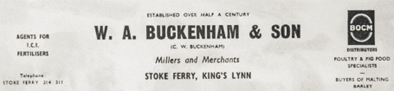
– the final chapter of the history of this family business in Stoke Ferry & Whittington –

When William Arthur Buckenham died in 1949 his coffin was carried by four employees W. Morley, A. White, F. Lawrence and F. Toll. Other office and mill staff included Miss I. M. Doe, R. J. Milsom, W. P. Parker, G. Rix, R. Rix, J. Brock, B. Fuller and T. Mayers. The ceremony was everything you would expect for the funeral of a local respected businessman.
William’s son, Christopher, a partner since 1928, took over the sole running the business.

In many ways Christopher appears to have been very much like his father. He was a member of the Parish Council, the Vicar’s Warden at All Saint’s Church. He was also involved in the local James Bradfield Voluntary Controlled School. In the summer following his father’s death, Christopher became President of the James Bradfield School Annual Sports Day. He presented the School Shield to Michael Wilby, captain of Nelson House. By permission of Hall Mark Hatcheries Ltd., this Sports Day was held at the rear of Park House. Christopher was interested in sports, including tennis, cricket, bowls, and Rugby Union. In the 1920s Christopher played for the WASPS.
In 1952, upon the retirement of Mr. C. H. Tuck, the business and premises of William H. Tuck & Son were acquired by Christopher. This expansion increased the Buckenham’s facilities for handling grain from farms in the local vicinity. Soon afterwards the business was advertised as Millers and Corn and Coal Merchants, poultry, cattle & pig food specialists, buyers of all grain including malting barley, supplier of fertiliser and weed control products, and having grain drying and seed corn milling facilities.
1964. The firm’s storage capacity was further increased. This was achieved by acquiring High Street holdings, which were formerly owned by Hall Mark Hatcheries.
In addition to a large feeding, stuffs, and fertiliser trade, by 1965 the business had a modern Grist Milling. This allowed dressing and powdering of seed corn as well as drying and cleaning all classes of grain. Much of the grain came from the increasing numbers of combine harvesters in the area. Malting barley was important and large quantities were handled. The machine was capable of dressing 4/5 tons of barley an hour. It was installed with intake hoppers capable of handling bulk lorries of up to 16 tons capacity. The delivery of the dressed grain was through a bulk tank of 20tons capacity. This enabled a lorry to be loaded at the rate of 3 tons per minute.
By this time the business employed 16 men and had five lorries (see image). They were used to collect and deliver all goods including coal and other forms of solid fuel. The firm acted as agents for I.C.I and Plant Protection Products as well as fertilisers from Fison’s Fertiliser Ltd, and West Norfolk Fertilisers Ltd.

1965: Loading outside the Granary, High Street Stoke Ferry.
Ray Brown in the doorway and probably Natt White on the lorry.
Malcolm Mycock recalls that they did little in the way of coal supplies. They stopped coal deliveries in the late 70s when Darkins cleared their yard. Darkins took on their customers.

The Gantry
The Gantry was with other buildings up the alley way. It was at the top of the yard where the house named The Hatcheries is now.
There was also a big oil-fueled engine at the back of The Granary. The engine is still around and makes appearances at old farm machinery rallies.

When Malcolm worked at the piggery at The Lodge, Stoke Ferry, he used to collect lots of Buckenham’s feed. Workers moved everything around with sack barrows – the sacks were stacked in heaps all around.
Malcom remembers Charlie Buckenham…. “He had big old glasses with big heavy frames“. He recalls, “There was a bowling green and tennis court at the back of Homeleigh. The Buckenham family kept themselves to themselves. They made feed at the Maltings at Whittington where my dad ran the granary. Jim Castle and Hayward and one other man were involved in running the business.
“The old photo showing Bridge Road was a small building at the end of the terraces. It was an office for Buckenham’s. My granddad had an allotment to the back of the building. Buckenham’s had offices where Tony White lives on Whittington Hill.”
William Buckenham, Christopher’s son, recalls, “Homeleigh was one big house and shrubbery. … to the North side there was a cottage/dairy with a large ground floor room. It had an inglenook fireplace and a spit. The gardens had fruit trees, a maze. There was an older house in the grounds. It had an enormous pitched roof. Before Bradfield School, it was run as a ‘dames school’. This was a school run by spinster ladies who lived on the premises. When the Reverend Thwaites died spinster aunts moved in to Homeleigh. The family later moved back to Osborne House from Homeleigh; they always kept position of Osborne House.
“The crinkle-cranckle wall had an opening framed by whale bones (possibly whale jaw bones from King’s Lynn?). This led to the Shrubbery with its bowling green which, in turn led to an orchard. I rember peaches and plums from fruit trees grown in recesses of the crinkle-cranckle wall.”
Christopher retired when William was 10 years old and died seven years later, in 1978.

Chrisristopher sold W. A. Buckenham & Sons to David Frame in 1971. David Frame was part of The Baltic Exchange. The local business then became part of a bigger, Europe-wide concern. During the years that followed there was an immediate change from being a family-run concern towards being a corporate firm.
John Ward: “When I was 15, my first job I worked on Buckenham’s pig farm where Big K is now. I didn’t like that and after three months I said I was leaving; I can’t work here. I told the boss. But they said don’t leave. You can work at the Mill in Whittington. That was the Maltings that’s just been developed as housing. I worked there for nine years. I was 15 when I started, and the oldest man was 75 – Bill Leamon. He went there after he was demobbed after the war. He went there asking if they had any work and they said that he had two weeks work, start tomorrow. He stayed there for 50 years. (see retirement article). Bill lived at West Dereham. There was Lennie Furner he was 70. He lived on Bradfield Place, opposite the Blue Bell, down at the bottom of the hill. And, there was Ernie Pettit, he lived at the station. His son was back in the village a few months ago, in the Corner Shop, reminiscing with people there. Pettit was a hard one, he was. They were all ex-army, but the best blokes I have ever worked with in my life. If I were to die tomorrow, I’d go back and work with them anytime. They had the patience to show you what to do. When I left there and went into the building trade. No one give a damn there, to be quite honest. If you didn’t know they wouldn’t show you, they didn’t have time to show you. But, those blokes showed me everything, they were top pals to work with.
“Inside the old maltings was amazing, old building, wooden floors. We used to carry the 16cwt sacks on our backs … they’d put one on my back and I’d be bent totally double as I staggered along. I was only 15 and I’d never done it before. That was 1980. Never knew Charlie Buckenham. Tucks had “The Granary” and what’s now The Moorings by the bridge. It was derelict and there was a large barn and two smaller ones. There was a steam engine in the steam house behind the Granary. Another steam engine was at the maltings, what’s now The Moorings.”
1970s. The business was now trading as W. A. Buckenham Agricultural Trading Limited. Based on Whittington Hill, there was a 15,000ton grain store with cleaning and drying machinery. This decade saw a stream of job advertisements for accountancy clerks, sales representatives, laboratory assistants, and office staff. There were also jobs for men to work in the Mill and Granary. The lab technicians tested the grain samples, oversaw the weighing of vehicles and recorded the movement of grain into the store. Most candidates for jobs replied to D. Eaglesham but other names are also mentioned in advertisements: M. Withers, J. M. Carruthers and J. Castle, and A. Drake.
In the summer of 1976 the company applied for planning permission. This was to develop a ‘recreation centre and marina’ on Bridge Road, Stoke Ferry. This is the site of what is now The Moorings.

1978. The company was described as an expanding, international concern.
1980, 4 December. Applied for the erection of a single storey buildings for pig rearing at Greenslades, Brandon Road, Methwold.
1981. They were advertising for Stockman/Woman positions at Hill Farm, Whittington and Glebe Farm, Methwold.
1982. Bonnett’s repaired the feedstuff mill and built pig gates and feeders for Baxter Parker’s pig units. They also installing plumbing and heating and extractor fans for the company.
1982 advertised for an experience pig person to run the farrowing accommodation of a new 600 sow unit.
1986, WAB, The Maltings, Whittington. Permitted development of installation of a boiler house.
Eaglesham still in adverts 1988

Bill and Lenny had worked for the company for many years. About 70 employees (past and present) attended the ceremony. Both were presented with cheques. Bill also received an electric drill. Lenny was given a camera subscribed for by their fellow employees. Their wives, Floss Leamon and Margaret Furner each received bouquets of flowers. Bill joined the company in 1970. He had worked for Tucks until the takeover, he lived at Station Road, West Dereham. Lenny was a mill hand who had joined the firm in 1946 and lived at 33 Fairfield Road. Stoke Ferry.
1989. Mrs A. Taylor was the contact for applicants to be an Accounts Clerk.
1990, 19 February. Whittington operations were taken over by Daisy Hill Limited and the name W. A. Buckenham was changed. Daisy Hill was part of the Usborne Group, the largest animal health provider in Humberside, Lincolnshire and North Yorkshire. It was a Stock Exchange listed company which was expanding in East Anglia. It had a new office in Hull as well as owning Daisy Hill Pigs in Yorkshire, Lincolnshire and Norfolk.

1990. P. Clarke contact person for job applicants.
1990, 15 June. Daisy Hill Feeds applied to turn the derelict Lancaster House, Old Methwold Road, Whittington into an office.

1990, 21 November. Announcement of the funeral of Jimmie Earl (Jim) Castle, of Beech House, Herne Lane, Beeston, formally Greenglades, Methwold. Jim was the Managing Director up to 1989 when he retired aged 60.
1990-91. Vernon Oak of Rectory Lane, Weeting. It took him one year to get £10,029 in compensation from Daisy Hill Feeds Limited. The company had sacked him as the Manager of the animal feed mill for gross misconduct. This was after nearly seven years of employment with the company. Michael Browne was the Company Director.
1991. Daisy Hill Feeds Limited auctioned off its ‘Modern Animal Feed, Milling Equipment, Vehicles Trailer and Forklift Truck’.
Sources:
Leave a Reply