
Moulsham House on the High Street, Stoke Ferry was built at the turn of the 18th Century and this article covers just some of its multiple uses and occupiers over the past 300 years.
In 1729, Moulsham House, its adjacent cottage, and the Old Chemist Shop appear to have been owned as one property by Henry Tingay. Henry was a cordwainer who repaid a mortgage of 40 pounds to his neighbours Francis (a blacksmith) and Elizabeth Ward.

In 1762, after the death of Henry Tingay, his son, also named Henry, sold the premises to Roger Micklefield for £100. Roger’s initials can still be seen on the churchyard side of the Old Chemist’s Shop (see above). Then started a period of it being a mix of business and domestic premises for various craftsmen and trades people including shoemakers, tailors and wool mercers.
In 1803 it was owned by the draper and grocer Abraham West, and the House continued as an important grocery and drapery the next 160 years.

Anthony Etheridge III (1769 – 1843) purchased the premises in 1833 and his family probably had the longest association with the premises. The Etheridges were local wine & spirit merchants & tallow chandlers and were amongst the wealthiest people in Stoke Ferry. Through business & land interests and marriage links the family were part of a small, tight-knit group of influential, entrepreneurial landowners who shaped the lives and landscape of Stoke Ferry and surrounding district. They were directly involved in every major development from enforcing property laws against the dispossessed, to drawing up Acts of Parliament for toll roads, enclosures, commutation of tithes and the new railway. Between 1769 – 1883 they owned several buildings in Stoke Ferry, including “The Cobbles” with its granary and storehouse on ‘The Hill’.
In 1836, Etheridge III sold Moulsham House to his son, Edward Wright Etheridge (1799 – 1883) for £800. Edward then sublet the premises to a number of tenants while he continued to own the shop with its chaise house, storehouses, stables, outbuildings and one acre of land.
In 1878 Edward sold Moulsham House to William Ashley for £1,000.
Late 1880s.Frederick Barnes, who had held positions of responsibility in Maple’s (an exclusive and upmarket furniture store in London)came to Stoke Ferry to run the grocery and drapery store at Moulsham House.
C. 1900, Albert William Fincham (d.1920) was a grocer and draper at Moulsham House. He ran the business with his wife Mrs. E. M. Fincham. The picture, below, shows Fincham’s delivery cart being used to collect hay. Below right is an enlargement where you may just be able to make out the words, “A.W. Fincham, Grocer, Stoke Ferry” painted on the side of the cart.

From at least 1908 the ground floor on the left hand side of Moulsham House was occupied two times a week by Barclays Bank; see Directory entry below left. The cheque (centre) is dated 1910 has the Stoke Ferry on its reverse side (image on right).

In 1965 Barclays was open every Monday and Thursday. It also dealt with transactions concerning other banks. The image below shows a security van outside of the bank.

For a period in the 1950s and 1960s an official from the Eastern Electricity Board was on hand all day Fridays at the Bank to take direct payments for quarterly electricity bills.
C. 1910. The picture, below right, shows a banner declaring ‘TEAS’ on sale at Moulsham House.

In 1958, Mr H. J. G. Hicks is resided at the house and his family ran the retail business.
From October 1962 and through the 1960s Mr & Mrs G. Thaine and their daughter Pat ran the shop (right) and created new lines in clothing, fabrics and shoes as well as knitting wools. China, glassware, towels and curtain materials were on sale along with a self-service grocery section.

In 1978, Eric and Irene Halliday and family moved into Moulsham House. Four years later, in April 1982, they received a worrying telegram from their son, Christopher. It read, “Will not be home for Easter – going South”. Christopher was a leading marine engineering mechanic aboard the HMS Coventry and ‘going South’ meant he was going to the Falklands War.

The following month it was reported that Christopher (right) had survived the bombing raid which sank the HMS Coventry on May 20th. The news ended a night of anguish for his parents. 20 of his fellow crew members had died and 29 injured. Christopher was among 130 members of the crew who were rescued from the capsized vessel.
In June Christopher was welcomed back to Moulsham House by his parents, brother Ian, girlfriend Karen Platt and friends. Christopher was quoted in the local press as saying, “There is no way to describe how I feel after what happens. Now I am just going to relax and try to forget it all.”

April 1982. There was an application for part of the premises to be used as a bed and breakfast.
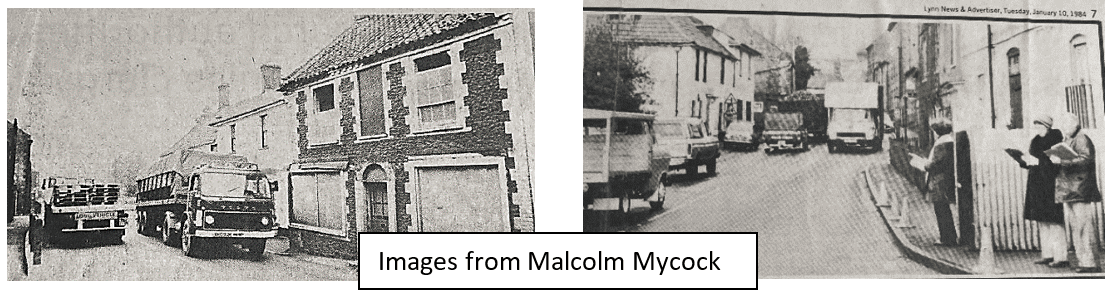
In 1984 Moulsham House was one of several buildings in the village at the centre of the successful local campaign to stop the intense levels of heavy traffic through the village High Street. Well done to SF Parish Council and local campaigners (see pictures below).

In 2010, under the Mayor’s Awards for Design in the Environment the owner of Moulsham House , Peter Martin, along with Swaffham-based builder G. V. Bensley received the ‘Highly Recommended’ award for their wonderful renovation of this historic building.
2024, the left side of the building is being used for holiday lets.
Sources used:
- A Farthing for the Ferryman, Richard L. Coates, The Harpsden Press, 2019.
- HMS Coventry: https://en.wikipedia.org/wiki/HMS_Coventry_(D118)
- Newspaper articles from: http://www.britishnewspaperarchive.co.uk
- Stoke Ferry & District History Group’s Community Archive.
- Stoke Ferry WI Golden Jubilee Scrapbook, 1965, Mrs Myfawy Manning and others, Norfolk Record Office.
Explore more buildings in our district with our interactive map.
Leave a Reply