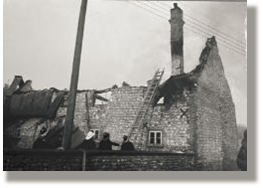

In 1972, dwellings known as Barn Cottages on Oxborough Road, Stoke Ferry (circled above). burned down
Malcolm Mycock recalls that Barn Cottages were converted from a long barn, hence their name. He remembers many a happy Christmas in the cottage his great aunt rented. In the end cottage next to Oxborough Road, lived Malcolm’s grandmother, Ethel. She was married to Jack Wilby; they moved out in about 1965. Ethel’s sister, Gladys lived in the row at No. 2.
The cottages were certainly not palatial. Malcolm says that, “Downstairs there was only one room with a little tiddly kitchen in the back. Five of the cottages had just one tap between them and had outside toilets.”
Basil Bruce lived in Barn Cottages for six months in 1938. On Facebook he recalled that they were overrun by cockroaches. Jam jars were placed on the fireplace every night to catch them.

The fire happened when the cottages were vacant and being renovated. Workmen were removing the thatch from the roof. They took the old thatch to the end of the garden and set it on fire. Unfortunately, they had left a trail of dry thatch, and the fire ran back to the cottages.
The fire made the chalk used to build the cottages unstable. The buildings had to be taken down. In fact, Malcolm remembers that “the cottages weren’t in great shape. He recalls the gable end of my grandmother’s cottage had to be rebuilt after it had fallen onto the road”.
Lynn Advertiser 3 Nov 1972


ELSAN Toilets
In 1924 Ephraim Louis Jackson founded his company which quickly became the largest manufacturer of non-mains toilets in the UK. His loos were also supplied to British colonies and the United States. The name ELSAN comes from Jackson’s initials EL with SAN for ‘sanitation’. In the early days, this was a primitive bucket and handle. It was sterilised by using the disinfectant, Jeyes Fluid which helped improve sanitation and keep down the smell.

Advert from the Agricultural Labourers’ Union’s Landworker Magazine, 1948
Paul Gillett used to live in Oxborough Road. She remembers that, “The old style ELSAN was essentially a large metal bucket, akin to a small oil drum, with a handle. ELSAN toilets did have a seat and lid attached to add a bit of dignity to the contraption! Disposal of its contents was a delicate affair. It usually involving a torchlit walk up the garden as dusk in order to dispose of the waste in a pit dug into the garden. The waste was then covered by successive layers of soil. Care was needed to avoid slipping into the pit. I suspect that most of the toilets in Oxborough Road were of similar antiquity.
One should also be aware that many in the rural communities of the 1900s worked on local farms. This continued until mechanisation became more prevalent. They would have had to use “rural facilities“ for a toilet break. These facilities included hedgerows or the occasional copse to relieve themselves. They could be one mile away from their home if ‘taken short’.”
Pearl Cannell of Little Lane, Stoke Ferry, remembers working as a girl in the fields in Hilgay the 1950s. “It was hard work in the fields. Whatever crop you were working on you were always bending and your back ached a lot. If you wanted to go to the toilet you had to go in the nearest dyke.” She went on to say, “When I grew up, we had a toilet in the garden at Hilgay. They used to empty it once a week; there was a horse with a tanker on the back.”
Paul Gillett also went on to say that “septic tanks did not become more widespread until the 1960s. I believe we had ours installed around 1953.“
Communal Wells
Paul also remembers, “As for flush toilets, they were not possible until mains water was laid on. In fact, most people relied on wells for all their water even beyond World War Two.
“We had a shared well with our neighbour, Miss Alfflat. During that time, she was apt to leave the well lid open, much to the consternation of my mother as my brother and I were still quite young. My father was in the RAF for a good part of the war. So my mother had to winch the water up. It quite a heavy task as the combined weight of the pail and water could’ be several kilos. In fact one litre of water equates to one kilo of weight.

“At Romer Farm next door, Mr. White and family had a cased pump in the corner of the yard behind the house. One pumped a long metal handle and the water gushed out through a metal spout into the pail on the ground beneath it. I do not know if it is still there as it was an interesting piece of ‘plumbing’. I imagine we did not have mains water until possibly the early 1950s as we had our flush toilet around 1952/3 so water was available then in Oxborough Road.”
The picture right, shows Pat Gillett (née Williamson) in 1942. She is aged just two, near the back door of her station house home. Her family lived next to Ernie Pettitt, the station porter. Water came by the barrel, delivered each day by train!
Doris Coates has written that “Every house or group of houses [in our area] had a well or pump to supply water. These wells are rarely seen now, but they are still there, under slabs, tarmac or topsoil.” Doris said that when her neighbours started work restoring Nos. 11 & 12 Furlong Road, “they uncovered an old well shaft less than three yards from the back door of their cottage. Its depth measured 49 feet at which point it was still dry, so when in use it must have been deeper. It was a remarkable piece of work, over three feet in diameter, perfectly circular, and beautifully bricked throughout the depth. Superb skill must have gone into boring and bricking to such a depth, with only the hand tools that would have been available in the early 19th century …it is a communal well, and all cottages in the group had right of access to it. Piped water was not available in Stoke Ferry until the late 1940s when work on the Buckenham Estate was started.”
From 1945 the country began to invest heavily in better housing for all and mains sanitation with indoor toilets became the expected standard.

Doris was told by Horace Brown that the wells in Furlong Road and at the Mill were the deepest in the village. She writes that “Documents from the late 1700s and early 1800s mention a well to the rear of Moulsham House, to which the occupants of The Lodge and Lodge Cottage had access, and the responsibility to share maintenance. Even when the water authority installed a water supply into the village, outlying houses were not brought into the scheme. When we [Doris and husband George] came to the village in 1953 there were still three houses on Limehouse Drove (now School Drove) not on mains water. The little train used to stop daily with churns of water at the Gatehouse Cottage. Beechwood had its own well, and the Watsons at Limehouse Fen on the Common (now demolished) used to come to the outside tap in the school yard for their supplies. This tap was in even greater demand when the train ceased to run and the Beechwood well water was declared unfit for human consumption, and all three families had the long haul to get their water.”
Sometimes buckets or other objects fell to the bottom of the well. Mrs. E. Sharpe of Boughton showed Doris how this problem was solved. She had a preserved grappling-iron with three prongs, known as ‘the creepers’. This was kept at the Bell pub in Boughton and would be lent to others in the village who let it down their well shafts on a long rope and grope for their lost buckets, etc.

In 2023 a very neat and circular sink hole (left) appeared at the back of the Blue Bell pub in Stoke Ferry (built c. 1790). After some excavation it was discovered to be the pub’s original well.
Do you have pictures of wells on your property? If so, then do comment below.
Sources:
- https://elsan.co.uk/our-history/
- Glimpses of Norfolk Life, Doris E. Coates, Harpsden Press, 1992
- Pictures of the burnt cottages from Paul and Pat Gillett
- Interviews, 2024, with Pam & Paul Gillett and Pearl Cannell.
3 responses to “A Burning Barn, ELSAN Toilets and Communal Wells”
-
Paul Gillet refers to Miss Alflatt, would that be Edie Alflatt and what address and year would that be please.
-
There was a well just outside the back door of our house in High Street (The Cottage) but it had fallen into disuse and become covered in grass, which became part of the lawn. It was only discovered when my grandfather visited, walked over it and felt the ground sink a bit. He then got a spade, plunged it in and discovered the well – where the family had regularly walked over it, unsuspecting. I don’t remember but assume it was hastily filled in.
Here at Wretton the well was between the cottage and the upslope outside earth closet. I remember grandfather drew a bucket of water from the well daily and it seemed the purest, sweetest, coldest water … until it was tested by the local authority and found to be full of bacteria! Unsurprisingly. Possibly soon after the cottage received a connection to the mains water supply.Helaine Wyett
-
Dear Marian
Pat Gillet has written in reponse to your comment above:
“Miss Alflatt lived in a cottage in Oxborough Road, one of two attached cottages next to Romer Farm. owned by Harry White.
Mr. and Mrs. Gillett were her neighbours and a few years after her death they bought the end cottage and it is now one dwelling. Miss Alflatt is buried in the village cemetery in the right hand section , which was used for burials of the Methodists and the left side as you enter was for the Church of England.I do not remember her Christian name and, in fact, it was very rare in our day that people were addressed informally, as they are today, even if one hardly knows them.
I believe a niece had her stone erected as she refers to her “aunt”. I only just remember her as she died when I was young, possibly around 1950, or a bit earlier.
No doubt, her gravestone is still standing so her Christian name will be visible.
Sorry I can’t be more helpful.”


Leave a Reply to blazevibrant07260dc377Cancel reply