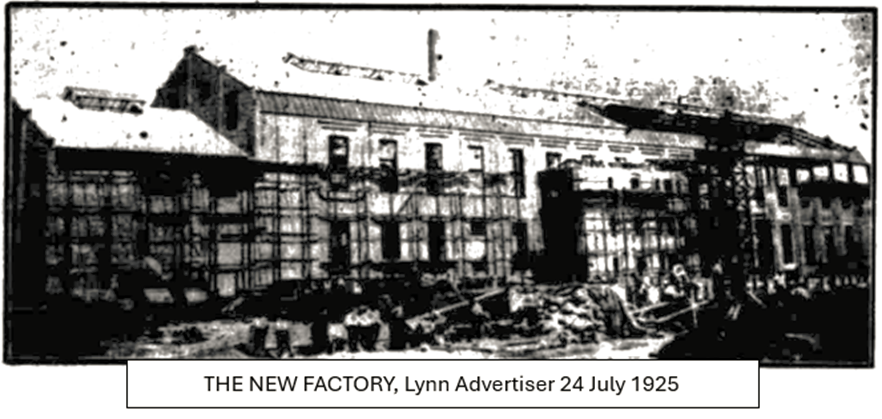
In 2025 a familiar local landmark, the largest sugar-beet factory in Europe, had a big birthday to celebrate. Founded one hundred years ago, the Wissington factory was the brainchild of local entrepreneur Mr. W. T. (Bill) Towler who had made his fortune as a potato salesman trading on London’s Spitalfields Market.
Having started out with less than £20 Bill made enough money to purchase several farms back home in the Fens. In September 1925 the Western Gazette described him as the driving force behind the opening of the sugar-beet factory on the Wissington Estate that was expected to employ hundreds of people as well as putting thousands of acres of land under cultivation for the first time.

(Above: Lynn Advertiser: 20 march 1925)
In June 1925 350,000 shares in the factory were on sale for £1 each. Having invested between £20,000 and £30,000 of his own money, Bill Towler, who at that time lived at Colville House in Littleport, persuaded other farmers to purchase shares in his enterprise.
Addressing the beet growers of Feltwell and Southern Fen, he was keen to emphasise that this was to be a strictly British endeavour, pointing out that up until then £134,000 of profits from the industry had gone to ‘Dutch pockets’. Admitting that British growers had learned a lot from the Dutch pioneers, he believed it was time ‘we left the cradle and made ourselves independent”.

As there was no road access to the site in 1925, the new factory owners leased the existing 13 miles of the Wissington light railway from the farmers who had built it and added another eight miles of track. Three tugs took goods from the factory to King’s Lynn, returning loaded with coal.
A tribute to Towler’s business acumen, the newly founded factory was running at full capacity within three months, and the Lynn Advertiser was able to report that the entire production of its first season was being sold to ‘Messrs Tate & Lyle at a remunerative figure’. Furthermore, the increase in beet being grown on hitherto untilled land meant that the sugar output was predicted to increase by fifty per cent the following year.
No doubt the ghost of Bill Towler would be delighted to know that his ambitious project has been given a hundredth birthday present in the form of a Royal Warrant granted by the King.
Survived and thrived
Over the years, ownership of the factory changed hands. In 1936 the Newmarket Journal reported that under the Sugar Industry (Reorganisation) Bill the rate of the government’s subsidy to the industry was to be reduced. The Bill also proposed the amalgamation of the eighteen existing factories into one organisation to be known as the British Sugar Corporation.
The outbreak of the Second World War in 1939 inevitably brought some major changes. In order to create space on merchant ships for other vital supplies, it was essential to increase the output of home-grown sugar. Wissington was one of the factories to which beet farmers could apply for assistance from the government. The incentives included a guaranteed price and market with seed supplied on credit as well as a cash advance of £5 per acre.
A meeting of the Western Highways Committee agreed that a road should be constructed to provide better access to the factory. The estimated cost of between £17,000 and £20,000 included widening the existing carriageway as well as strengthening the bridge over the River Wissey. It meant that the growers were saved the cost of unloading from road vehicles into railway trucks. It also eliminated the paying of the one shilling per ton haulage charge from the private siding up to the factory.

The Ministry of Agriculture took over the railway line and used Italian prisoners of war to refurbish it as well as building the road. The Ministry continued to run it until it finally closed in 1982.
With the help of women from the Women’s Land Army, farmers worked hard to feed the nation in what was known as the Battle for Bread. In 1941 a thousand acres of what had been weed-infested fenland only a year before produced 1,000 tons of sugar beet, 1,000 tons of potatoes and 10,000 hundredweight of oats.
Also contributing to the war effort was the factory’s own Home Guard platoon. The Lynn Advertiser, April 27th, 1999, featured the platoon with a photo sent in by Stoke Ferry resident, Roland Denny, who was a former platoon member.

Peacetime problems
After the outbreak of peace in 1945, times were challenging as the country slowly rebuilt its post-war economy. The government needed to be resourceful and in 1949 Wissington was one of ten factories that helped to convert a surplus of potatoes into cattle feed. The beet-slicing machines were used to cut up 160,000 tons of potatoes before they were dried in the pulp-driers and bagged up for distribution to farmers.
The weather didn’t help matters. After the wet winter of 1951, beet growers struggled to harvest their crop as their machines were bogged down in the muddy fields. Some farmers were forced to return to traditional methods by using horses to lift the last acres of beet.

Worse was to come in the severe winter of 1963. The picture, above, shows cloth-capped farmworkers on Park Farm, Stow Bardolph using hammers on every individual beet in a clamp to remove the frozen soil before the crop could be sent to the factory.

Lifting beet at Buckingham, 1952 – Source: Jackie Clingo
Fun and games
As most of its workforce lived locally, British Sugar provided a daily bus service to ferry people from nearby villages. Others cycled the short distance to Wissington. By all accounts, they were a sociable crowd. More than one happy couple met and married while working there. Built by volunteers, the clubhouse at the company’s sports ground at Bexwell Road in Downham proved the ideal venue for wedding receptions. In 1953 a children’s party to mark the Queen’s coronation was held there. Around 120 youngsters were entertained to tea and games, and each one was presented with a souvenir pencil. Not to be left out, the adults had their own fun with Mrs. J. R. Martin winning the best ankle contest and Mr. F. Stimpson triumphantly bowling for a pig.

A party for the children of employees (see right) was a regular summer fixture and in 1956 the occasion began with a fancy dress parade around the field, accompanied by the Hilgay Excelsior Band Other highlights included a Punch and Judy show and ‘Lawrenco the Magician’ who entertained the children with conjuring tricks. More fun was had at the Christmas parties which were organised by the sports club social committee. One year Santa arrived in style in a pony and trap driving through the streets of Downham before handing out presents. Transport was provided to take the weary partygoers home.
Remembering the Sixties
During the decade in which Prime Minister Harold Wilson urged industry to take advantage of ‘the white heat of technology’, Wissington was firmly in the forefront of modernisation. A new diffusion extractor had been installed at the start of the 1957 campaign. The huge steel cylinder, one of only thirteen in the whole country, was capable of handling one hundred tons of beet an hour. Works manager Mr. A. J. Dyke was pictured in the Lynn Advertiser demonstrating the automatic control panel.

In 1965 the company introduced a pilot scheme to its weighbridge system. The new punched-tape process speeded up the daily movement of 400 vehicles into the factory. This allowed payment to be made growers in two days instead of four. In the same year, Edward Heath, then leader of the Conservative party, visited the factory. Accompanied by the technical executive Mr. W. Boast, general manager Mr. R. E. Hughes and works manager Mr. R. N. Smith, the future prime minister inspected the loading facilities as well as the chemical laboratory and learned that Wissington was the county’s first automated beet factory.
Author: Marion Clarke. Research: Lauren Arellano. Stoke Ferry & District History Group
To read Part 2 of the factory’s history – just click here
Comments
2 responses to “Wissington Sugar Factory. Part 1: 1925-1970”
[…] Click here to read Part 1 of the factory’s history: 1925-1970 […]
[…] determined to create a better life for his family. Having secured work on the early design and establishment of the Wissington factory, he set off across the country to a new and unknown life in the East. The factory was set up to […]