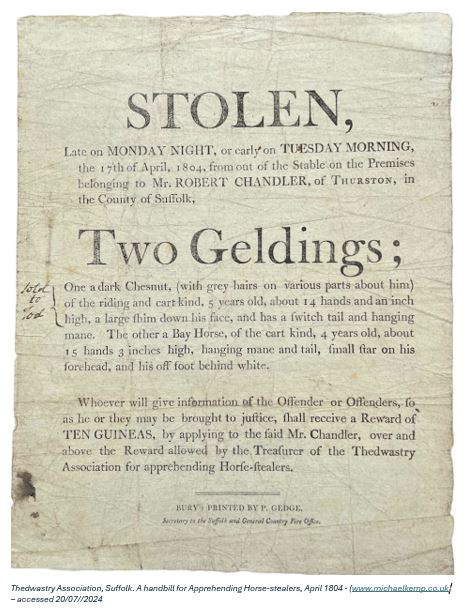

In Georgian England and Wales horse stealing was a common occurrence:
- 1810-18 there were almost 900 suspected horse thieves in England and Wales.
- 1826-31 there were 935 convictions.
- Some, and possibly most, thefts were unrecorded as either the thieves and/or the horses were not found.
In the 18th century the number of horses in use in the countryside grew considerably. There were a number of reasons for this, including:
- The growth of internal trade
- The decline in the use of oxen
- The growth in arable farming which led to an increased demand and use of traction horses,
- Improvements to road systems led to a rise in the number of riding and working horses.
- Post Chaise and other road service developments also increased horse numbers
It is estimated that in 1811 there were 1.3 million horses in Great Britain about 10 per 100 people, while in 1871 there were 2.1 million horses or eight per 100 people.
The penalties for committing the capital crime of horse stealing during our period in question was a prison conviction, transportation, or execution. From around the 1750s until 1818, between 13% and 14% of persons convicted of horse theft in Norfolk courts were executed. The death penalty for stealing horses, sheep and cattle was only abolished in 1832 by which time executions for horse theft had been rare for some time.
The horse thieves were usually men in their late 20s or 30s and employed in some way in agriculture. These men usually worked alone rather than in organised groups. Go to the end of this post to see examples of horse stealing convictions in our district.
Most of the horses that were stolen were everyday working horses rather than thoroughbreds or the more valuable farm horses. But stealing and selling a horse, if successful, was profitable even when the thief sold off a horse at a discount.
Gentlemen’s Associations for apprehending Horse-stealers
In the days before any police force was in place, the establishment of Gentlemen’s Associations for apprehending Horse-stealers for specific districts across the country (often based on the old administrative districts of Hundreds) was felt necessary by those with wealth, land and property.
Each member or subscriber of an Association paid an annual fee and could be fined for non-attendance at an Association’s Annual Meetings. The money raised was used to publish hand bills and descriptions of a members’ stolen property in newspapers. Importantly the money was also used to offer rewards for information leading to the recovery of stolen property.
The Articles of an Association would specify the rewards to be offered to anyone apprehending and convicting offenders who had committed a crime. Different Associations offered differing amounts for awards for the conviction of horse thieves, varying between five and ten Guineas. Below are the rewards on offer from the Great Oakley Association in Essex:
- Stealing of horses or cattle: 5 Guineas (£5.5s)
- House breaking: 5 Guineas (£5.5s)
- Highway or footpad robbery: 5 Guineas (£5.5s)
- Breaking open barns, stables or outhouses: 3 Guineas (£3.3s)
- Stealing poultry, turnips, apples, pears, damaging hedges etc: 1 Guinea (£1.1s)
Two Local Associations for apprehending Horse-stealers
1. The Swaffham Association
The first notice we found of the Swaffham Association is for 1773.
1773, Annual Meeting of the Swaffham Association
“At a Meeting of the Gentlemen in the Association for apprehending Horse-stealers, held at the Crown Inn [Swaffham], on Saturday, June 5, 1773, It was agreed by a considerable Majority of the Subscribers there present, that each Subscriber who did not chose to attend the annual Meetings in future, should forfeit the Sum of One Shilling for Non-Attendance; such Forfeitures to be appropriated to the Use of the public Fund, and paid into the Hands of the Treasurer within Twelve Months from such Meeting, or be Excluded all Benefit arising from the Association…The Public are desired to take Notice, agreeable to the Articles of the Association, that as an Encouragement for the immediate apprehending of Offenders, a Reward of TEN GUINEAS, with an allowance of every reasonable Expense, will be paid to any Person or Persons who shall apprehend any one who stole, or was concerned with stealing, any Horse, Mare, Colt, or Filly, from the underwritten Subscribers, so that he, she, or they, be thereof lawfully convicted, by applying to Christ. Rodwell, Treasurer, at Swaffham.” (Ipswich Journal 04.09.1773)
1776, The Swaffham Association: Servants Certificates of Good Conduct
“At the annual Meeting of the Gentlemen in the Association for apprehending of Horse-stealers, held at the Crown Inn [Swaffham] … it be recommended to every Subscriber not to hire any Servant in Husbandry, who lived the preceding Year with any Gentleman in this Association, without a Certificate of his good Conduct from under the Hand of his late Master…” (Norfolk Chronicle 07.09.1776)
1831, the Swaffham Association was re-established
Because of the tide of agricultural poverty and unrest, the Swaffham Association was re-established in both 1826 and 1831 offering rewards concerning a wide range of activities: burglary and horse, cattle, sheep, pig, corn, hay, seed, wool and fowl stealing:
“With a view to counteract the alarming increase in Theft in this Neighbourhood, and for the purpose of Mutual Protection of Property, we the undersigned have formed an Association to reward liberally Constables, Shepherds, and others, who exert themselves in the Detection of Offenders, to be paid upon Conviction of any undermentioned Trespasses or Depredations, committed on the Property of Members of this Association, viz.:- Burglary, Horse, Cattle, Shep, Pig, Corn, Hay, Seed, Wool, and Fowl STEALING.“
The following names were listed as members of the Association: “Andrew Fountaine, Esq. Narford Hall, Samuel, Tyssen, Esq. Narburgh Hall, W. L. W. Chute, Esq. South Pickenham Hall, H. Berney Caldwell, Esq. Hilborough Hall, Anthony Hammond, Esq. West-acre High House, Rev. Thomas Young, Necton.” This was followed with 24 names of land/property owners from Swaffham, Sporle, Castle Acre, South Acre, Wet Acre, Narburgh, Marham, East Walton, Narford, Newton, Gayton, Gayton Thorpe, Lexham, and Beachamwell. (Norfolk Chronicle, 19 November 1831, Page 3)
1773-1798. Subscribers to the Swaffham Association from Stoke Ferry district included:
- Stoke Ferry – H. Helsham, James Bradfield, John Fairchild, Thomas Forley, T. Goddard, William Larner, R. Micklefield, James Jacob, Thomas Snasdell, Roper Weatherall, Edward Squire (Squire supplied coal from Oxborough Hythe)
- Barton Bendish – Mrs. Bayley
- Boughton – Thomas Carter, John Hull, John Kemps and Robert Thorold
- Cockley Cley – James Crowe, Thomas Crowe, J. Thompson, R. Thompson
- Crimplesham – Thomas Vincent
- Oxborough – John Coote, John Harvey, Rev. Mr. White
2. The Stoke Ferry Association
The Stoke Ferry Association was established in 1793. The last published notice we have found is fifty years later, in 1843.
1793-1843: Subscribers to the Stoke Ferry Association For Prosecuting Horse Stealers, and other Felons consisted of:
- Stoke Ferry: Henry Linhook Helsham, Roger Micklefield, James Bradfield, Mr. Jas. Bloomfield, Richa. Curtis, Anthony Etheridge, John Morley, William. Nurle, James Ward, E. Youngman
- Barton Bendish: Thomas Morrill, Thomas Ebden, Rev. Robert Forby
- Boughton: Mr. Ro. Thorrold
- Foulden: William Filbee
- Methwold: Mr. W. H. Clarke, Ab. Cock, John Caney, Geo. Eyres, Robert King, John Newton, Jas. Wortley, John Wortley
- Northwold: Mr. H. V. Foyster, John Wright, John Young
- Oxborough: Sir Richard Bedingfeld, Bart
- Wereham: Rev. Hardy Robinson, Rev. James Oakes, Mr. Rob. Catton, John Houchen, Thos. Ingey
- Wretton: Thomas Rolfe. Richard Wallis
- West Dereham: William. Dungrey, John Filbee, Mast. Godfrey, John Oldham
June 1793, The first meeting of the Stoke Ferry Association
“Stoke Ferry ASSOCIATION, Norfolk, For Prosecuting Horse Stealers, and other Felons. At a meeting of the Gentlemen and others, residing within the hundred and half of CLACKCLOSE, and adjacent hundreds in the said county, associated for prosecuting Horse Stealers and other Felons, held the 13th day of June 1793, at the Crown Inn in Stoke Ferry, it was then and there agreed, that Mr. ANTHONY ETHERIDGE, of Stoke Ferry aforesaid, should be Treasurer for the year ensuing; and that the articles of this Association, and all orders therein contained, should remain and be in full force until the next annual meeting, to be held on the 14th of June, 1794; at the place aforesaid; and that a reward of FIVE GUINEAS (together with all reasonable charges) be paid by the Treasurer to any person or persons who should apprehend and prosecute to conviction the stealer of any horse, mare, of gelding, from any of the undermentioned subscribers; and also a proper reward to any person or persons who should also apprehend or prosecute to conviction any other person or persons guilty of felony and other offenses against any of the said subscribers. (BURY AND NORWICH POST 31.07.1793)
Stoke Ferry Association: Annual subscription, 10s. 6d.
“STOKE FERRY ASSOCIATION Annual General Meeting of the Association for Prosecuting Horse-stealers and other Felons, will be held at the Crown Inn, on Thursday the 10th of June, when it is requested that those Members who do not attend will order their further Subscriptions of 10s. 6d. to be paid. ANTHONY ETHERIDGE, Treasurer. Stoke-Ferry, May 26, 1802.” (Norfolk Chronicle 05.06.1802)
Stoke Ferry Association: Death of Anthony Etheridge:
“ The Stoke Ferry Association for the Prosecution of Felons held its anniversary on Friday last; when, previous to any other business, the meeting preceded to the election of a Treasurer to supply the vacancy occasioned by the lamented death of the late Mr.[Anthony] Etheridge, who, if he had lived but short time longer, would have completed the 50th anniversary had he attended in that capacity, without a single intermission! Mr. Edward Etheridge was unanimously chosen as successor to his father.” (Bury and Norwich Post 14.06.1843)
1778 – 1816: Local press announcements concerning Horse Stealing
1778
“Wednesday was committed to the [Norwich] Castle by John Buxton, Esq. Thomas Nurse, of Oxborough, labourer, charged with stealing a bay-brown gelding from the common pasture of Mr. Denton, of Brandon aforesaid, merchant, and selling the same at Harling fair for seven guineas.” (Norfolk Chronicle 09.05.1778)
1780
“WRETTON, Jan. 24, 1780. Left at the RED LION at Wretton, on Sunday the 19th December, 1779, by William Broughton, lately committed to Norwich Castle for Horse-stealing, a CHESTNUT MARE, with a blaze down her Face, four white Legs, and a Saddle and Bridle. If the said Mare, Saddle, and Bridle, be not taken away, and the Expenses paid before the 21st Day of February next, they will be sold for the Payment of the keeping and other Expenses. Mary Parlet.” (Norfolk Chronicle 29.01.1780)
1790
“On Tuesday last was committed to the [Norwich] Castle by T. Berners Plestow Esq. James Day, alias Charles Sterne, of Fressingfield, in Suffolk, supposed to be an old offender, charged with the oaths of William Bradfield, gent, of Stoke-ferry [sic], and John Turner, of Freston, near Bolton, Lincolnshire, with stealing from a pasture in Stoke aforementioned, on the night of 21st of May last, a black mare, the property of the said Mr. Bradfield. The said Day has been near three weeks in Bolton goal; he had led his pursuers a chase of several hundred miles, before he was taken. He is near six feet high, about 28 years of age, has long darkish hair, and is well dressed.” (Norfolk Chronicle 19.06.1790)
1790 (see also above)
“James Day, otherwise known as Charles Sterne, for stealing a black mare, property of James Bradfield gent. of Stoke Ferry, was capitally convicted, and received sentence of death; but was reprieved before the Judges left town.” (Norfolk Chronicle 31.07.1790)
1804
“A BAY MARE, between the Cart and Nag kind, about 14½ hands high, 3 years old, hanging mane, and long tail, a white mark down her face, her near foot behind hurt with a trace. Whoever will give information of any person or persons concerned in stealing the same, shall, on his or their conviction, receive a reward of FIVE GUINEAS, from the Stoke Ferry Association for prosecuting Felons, by applying to Mr. Anth. Etheridge, Treasurer; and if strayed, any person returning her to Mr. Wortley, shall be handsomely rewarded for their trouble. Stoke Ferry, Sept. 17, 1804.” (Bury and Norwich Post 19.09.1804)
1811
“A BRIGHT BAY COLT, rising three years old, nearly blood, not any white marks about him, 14 hands high, lately from the Breaker’s hands, and is chafed on the nose with the halter, carries his tail a little to the near side, and on the point of his near shoulder is a small hole, had from his foaling. — lf strayed, any person who will deliver him safe to Mr. John Atmore, shall be handsomely rewarded for their trouble ; and if stolen, a Reward of Five Guineas will be given to him or them that shall apprehend any per- son who stole the same, by the Stoke Ferry Association, on conviction ; and a further Reward of Ten Guineas will be given by Timothy Winkfield, of Stoke Ferry. NORFOLK.” (Bury and Norwich Post 11.12.1811)
1813
“LOST supposed to be STOLEN, From the premises of Mr. John Blomfield, of Newton, about the latter end of July last. A Bright Bay HORSE PONEY, about 15 hands high, hanging mane, cut tail, and a star on his forehead; if stolen, whoever will give information of the person or persons concerned thereon shall, upon conviction, be paid the sum of FIVE GUINEAS, by Mr. Blomfield of Oxborough, and the further sum of FIVE GUINEAS by the Stoke Ferry Association for the Prosecution of Fellons, besides the Reward given by Act of Parliament; if strayed, any person giving information to the said Mr. Blomfield, of Newton, or Mr. Blomfield of Oxborough, where the poney may be found, shall be paid all reasonable charges, and handsomely rewarded for their trouble.” (Bury and Norwich Post 28.08.1813)
1816
“FELONY. – TEN POUNDS REWARD. WHEREAS THOMAS WORTLEY, of Eastmore[sic], near Stoke-Ferry, in the county of Norfolk, stands charged with Felony, and a Warrant has been issued for his apprehension by one of Majesty’s Justices of the Peace, acting in and for the said county; whoever will apprehend and lodge the said Thomas Worthy in one of his Majesty’s Gaols, or otherwise keep him in safe custody, and give notice thereof to Anthony Etheridge, Treasure of the Stoke Association, shall receive a Reward of TEN POUNDS, over and above such Reward as is allowed by Act of Parliament. The said Thomas Worthy is about 45 years of age, 5 feet 6 inches high, short dark hair, brown eyes, dark complexion, thinnish countenance, and generally smiles when he speaks, and that in rather a low voice; is very active, and well known in Marshland and Lincolnshire, as a gatherer of Lapwings’ Eggs.” (Bury and Norwich Post 03.01.1816)
1863
“Career of a Convict.- On Tuesday last, a young man, named Samuel Akers, aged 27, was lodged in the Lynn goal, on a charge of stealing and disposing of a horse, gig, and harness, the property of Mr. C. Hewson, of the Three Tuns Inn, Church-street. He had been to Whittlesey and Peterborough; at the former place incurring suspicion of having stolen a ring from a bedroom at the Wheatsheaf inn, where he stayed; and at the latter being detained on suspicion of the theft of the horse and gig, until the arrival of the Lynn superintendent and Mr. Hewson, to identify him. The prisoner is the son of a notorious brothel keeper, and commenced his criminal career at a very early age. In 1845, he was sentence at the Lynn quarter sessions to seven days’ imprisonment and a whipping, for stealing a cloak. In April following, he was convicted of stealing a till, containing a quantity of silver, and sentence to seven years’ transportation. Obtaining a “ticket-0f-leave” coma he returned to his home and his former pursuits. Convicted at Wisbech of stealing a coat, he was sentence to ten years’ transportation, from which he returned on the 10th October last. On Monday last he was summoned for an assault on his mother, but did not appear, being engaged, no doubt, in the ” business” which has led to his present detention.” (Norfolk Chronicle, 31 January 1863, Page 6)
3 responses to “Horse Stealing in the Stoke Ferry District: from the late-18th century to mid-19th century”
[…] Fincham, Barton Bendish, Eastmoor, Boughton and Oxborough to meet at the Crown Inn to establish an Association for the Prosecution of Felonies. Other prominent locals were also founding members of this landowning […]
[…] rural and urban areas. Across Norfolk and elsewhere in England landowners and larger farmers formed Associations For Prosecuting Horse Stealers, and other Felons offering rewards for the capture of thieves. These associations proved to be fairly ineffective and […]
[…] ought also to recall the Association For Prosecuting Horse Stealers, and other Felons. Such Associations were the precursor of today’s police […]