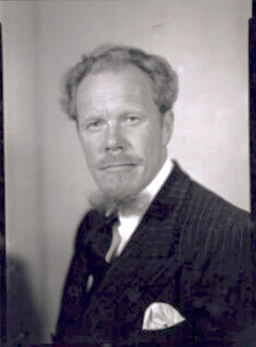

Lt. Commander Merlin Theodore Minshall was a flamboyant and larger-than-life character who lived in Stoke Ferry from January 1973 until his death in 1987. In his obituary The Times described Minshall as “a rumbustious adventurer who had been born three or four centuries too late”. Minshall’s life was the subject of a recent talk and discussion led by Roger Warner of Whittington. Roger is a Committee member of the Stoke Ferry & District History Group, and this article is based on Roger’s research.
Merlin Minshall was born in 1907 into the British elite. His father was a newspaper proprietor who ensured that the young Merlin had a privileged upbringing and an education at the finest schools. Merlin studied architecture at London University. But he found high society suffocating and not to his liking. British aristocracy, of which he was a member, had a strict code of exclusive clubs, dinner parties and horse race meetings. Merlin described that lifestyle as a prison, and it was not for him. Adventure abounded through his veins. When he was still a young boy, he witnessed his mother leave social conventions aside to work as a World War One spy for British intelligence. By turning his back on a life of luxury to go after adventure, Merlin was surely following in his mother’s footsteps.
He perchanced one day In the early 1930s to come up on an article in Autocar magazine about the upcoming Monte Carlo Rally. The rally was one of the most prestigious and challenging car races in Europe. The route consisted of icy roads, snowy hills and steep mountain passes. The race extended for a grueling 3000 miles. That was just the sort of thing that Merlin craved. Using his technical knowledge, he crafted his vehicle, a Singer 1.5 litre Le Mans Special, with steering linked headlamps. For company Merlin had a sophisticated, glamorous partner named Yvette. The race started well but he ran into trouble when he was arrested by Nazi troops for speeding! It took Yvette’s guile and charm to get back in the race when they finished in fifth position and first position for his class.

Turning his attention from land to water, Merlin traded his sports car for a sea-going barge, “The Hawk”. It was in this vessel that he became the first Englishman to sail across Europe to the Black Sea. Starting from Le Havre in France and accompanied by his wife Elizabeth Loveday, he planned to navigate through the Bavarian Alps and down the Danube. Unfortunately, this proved too much for Elizabeth who felt trapped by the close quarters of the boat. Before the end of the journey, she disembarked along the Danube and left Merlin and her marriage behind.
Undeterred, Merlin picked up a few temporary passengers, enlisting them as makeshift crew members. One such traveler was an alluring German woman named Lisa Kaltenbrunner, whose quiet demeanour and piercing blue eyes concealed a dark secret. Her presence was no coincidence. She was a spy, sent by the Nazi German government. Her job was to assess if and where Merlin might be scouting for oil storage facilities along the Danube for British intelligence. Although he says he was not at this time engaged in espionage, the lovely Lisa took no chances and tried to poison him. Fortunately, Merlin did not succumb, but he was ill four days.

Merlin’s cross-Europe trip is featured on 36 pages of the May 1937 edition of The National Geographic and a copy of the magazine, along with Merlin’s autobiography, Gilt Edged, forms part of our local history archive.
As World War Two erupted, Merlin found himself in Room 39 of the Admiralty and face to face with Commander Ian Fleming. Merlin told Flemming of his bold plans, forged from his maritime adventures,, to disrupt German supply lines. Fleming was doubtful at first, but then realised Merlin possessed a rare and invaluable understanding of the River Danube. Merlin was placed in the Royal Navy Reserves and he and Fleming devised a high stakes mission, with the help of World War One veteran, Rear Admiral Godfrey. It was Admiral Godfrey’s stern, and pragmatic approach which probably inspired the character ‘M’ in Ian Fleming’s James Bond novels. Fleming recognised Merlin’s appetite for risk and his ability to operate under pressure. During the early years of the war the Danube was an artery of transport for German supplies through neutral Romania. Disruption of these supplies would give the Allies a considerable advantage. Their plan was to use explosives to block the narrowest section of the river, known as the Iron Gate. This was to be done by sinking six cement barges and then bringing the team to safety in a high speed rescue launch. For this mission Merlin received intense training at a secret sabotage school in Guildford. In 1940, he led his covert team to Bucharest in Romania to execute the operation. Bucharest was a centre of espionage, with agents from all sides lurking in the shadows. It was a dangerous place where trust was scarce, and betrayal would mean a fatal end.

Once the mission was set in motion, Merlin and his team sailed along the Danube, but disaster struck before they reached their target, their vessels ran out of fuel. Suspecting Romanian sabotage, Merlin and his team were at the mercy of Romanian officials and Nazi gunfire. Chaos erupted and Merlin got his men onto his launch and escaped in a hail of gunfire. The mission was a failure, forcing the British government to disown any involvement. However, Ian Fleming stood by Merlin and went on to involve him in several operations before the war ended. Merlin always, insisted, and probably with good cause, that Flemming used him as the basis for his Commander James Bond character. Indeed, after the war Merlin Minshall himself retired as a Lt. Commander.
In the post-war 1950s Merlin owned the Chelsea Travel Centre on the King’s Road, Chelsea, London. From here he organised adventurous holiday trips to Eastern Europe and delivered talks on his life of audacious adventure.
Later, in the 1960s he led an election campaign from a caravan across County Durham as part of his attempt to become a Liberal MP.
In 1972, Merlin, his wife, Christina Marjorie Zambra, and four sons moved to Stoke Ferry and lived in the house now named ‘The Cottage’, 9 Wretton Road. It took a year to make the premises habitable. This was achieved through constant visits in a Bedford van to Geoff Allen’s wood yard in the village.


The new family home used to be known as ‘The Old Bakery’ and its position can be seen on the image left. During his time in Stoke Ferry Merlin taught Architecture at a local college and gave talks to various community groups on his life’s adventures. In 1981 he was part of the campaign to save the pine tree that stands outside of the ‘Whole Earth’ Chinese takeaway on Buckenham Drive (see below). He is quoted in the Lynn Advertiser as saying, “It will be cut down over my dead body”.

Merlin always retained his aura of authority and his son, Chris, remembers looking out of the window Methwold High School and seeing his father in a yellow Triumph Dolomite paying a visit to the staff team who Merlin considered were not doing their job well enough! Roger Warner had

occasion to meet up with Merlin and he remembers that the monocle-wearing Minshall always wore a flower in his buttonhole – a flamboyant and colourful character indeed. Local resident Ray Ward also recalls his near neighbour Merlin. Ray says that Merlin used to tell folks about his life and the James Bond connection. Locals found his stories hard to believe. But once they had read his autobiography, Guilt Edged’, they were more convinced!
Merlin Minshall’s adventurous spirit and larger-than-life personality left a lasting impression on those who knew him. His life was a testament to his relentless pursuit of adventure and excitement; a reminder that sometimes, real life can be just as thrilling as fiction.

Sources of information:
- The National Geographic Magazine, May 1937 (includes a long illustrated article by Merlin Minshall)
- Gilt Edged, Merlin Minshall, 1977 (autobiography by Merlin Minshall)
- Both of the above can be loaned to members from our Community History Archive
Roger Warner, Committee Member, Stoke Ferry & District History Group